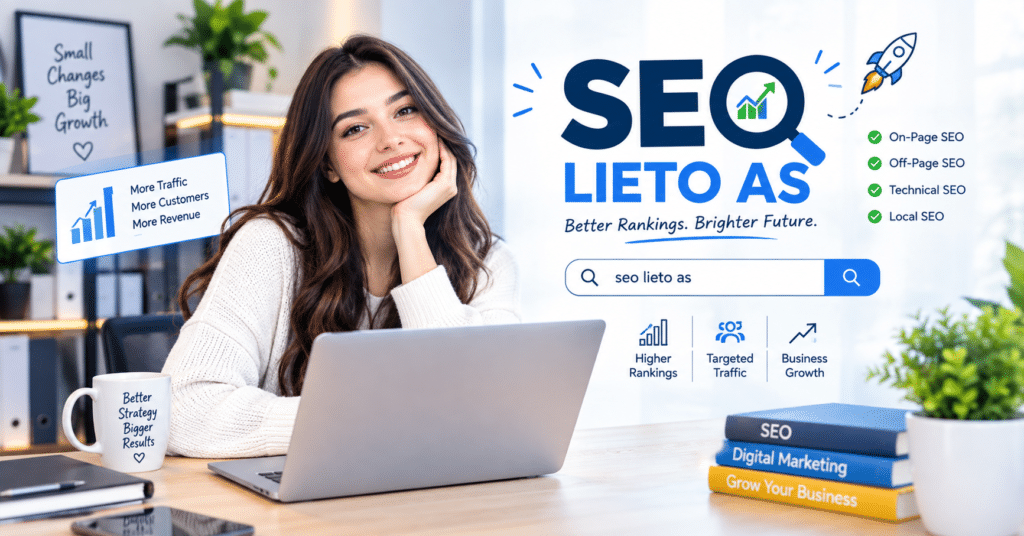
SEO Lite AS – Grow Your Business with Smarter SEO Strategies
Search has changed. Ranking on page one used to be the finish line — now Google increasingly answers user queries directly inside AI Overviews before a single blue link is ever clicked. If your website isn’t structured, optimized, and authoritative enough to be pulled into these AI-generated answers, you’re invisible at the exact moment your customer is deciding who to trust.
This guide breaks down what AI Overview optimization actually means, how it’s different from traditional SEO, and exactly what it takes to make your website “AI-rankable” on Google in 2026 and beyond. Whether you’re a startup, a local service business, or an eCommerce brand, understanding this shift is no longer optional — it’s the new foundation of organic SEO service sseo lieto as .
What Is Google AI Overview?
Google AI Overview is a generative, AI-powered summary that appears at the top of search results for many queries, synthesizing information from multiple websites into a single, conversational answer. Instead of showing ten blue links, Google now shows a short summary written by its AI model — often with a handful of cited sources underneath.
For businesses, this means two things:
- Fewer clicks are going to traditional organic listings, because users often get their answer without leaving the search page.
- Being cited as a source inside the AI Overview is the new “position zero” — arguably more valuable than a standard #1 ranking, because it signals authority and trust before the user even reaches your site.
AI Overviews pull from a mix of signals: content clarity, structured data, topical authority, freshness, and how well a page answers the specific intent behind a query. It’s less about stuffing keywords and more about being the clearest, most trustworthy answer available on the web.
Why Ranking in AI Overviews Matters for Your Business
Businesses that ignore AI Overview optimization risk losing visibility even if their traditional rankings stay strong. Here’s why it matters:
- Zero-click searches are rising. More users get answers without visiting any website — if you’re not cited, you don’t exist in that moment.
- Trust transfers instantly. Being featured as a cited source inside an AI-generated answer builds instant credibility with the searcher.
- Voice and AI assistants rely on the same data. The same structured, well-optimized content that ranks in AI Overviews also powers voice search and AI chat assistants like Gemini.
- Competitive advantage is still wide open. Most small and mid-sized businesses haven’t adapted their content yet, which means early movers have a real opportunity to dominate this new search layer.
- It compounds with traditional SEO. The practices that help you rank in AI Overviews — clear structure, strong E-E-A-T, fast technical performance — also improve your classic organic rankings.
How AI Overview Search Differs From Traditional SEO
Traditional SEO has long focused on keyword density, backlinks, and page-level optimization to climb the traditional ten blue links. AI Overview visibility requires a broader, more holistic approach:
| Traditional SEO Focus | AI Overview / AI-Rankable Focus |
|---|---|
| Keyword placement and density | Clear, direct answers to specific questions |
| Individual page ranking | Topical authority across a cluster of related content |
| Meta tags and title optimization | Structured data (schema) that machines can parse |
| Backlink quantity | Source credibility and citation-worthiness |
| Long-form content for depth | Concise, extractable answer blocks within long-form content |
| Domain authority | Demonstrated experience, expertise, authority, and trust (E-E-A-T) |
The takeaway: AI Overview optimization doesn’t replace traditional SEO — it builds on top of it. You still need solid technical SEO, on-page optimization, and backlinks. But you now also need content engineered to be quotable, structured, and unambiguous so an AI model can confidently lift a sentence or paragraph and attribute it to your site.
Keyword Strategy for AI Overview Visibility
Keyword research remains the backbone of any SEO campaign, but the approach shifts when you’re optimizing for AI-generated answers.
Focus on Question-Based and Conversational Keywords
AI Overviews are triggered most often by questions and informational queries — “what is,” “how to,” “best way to,” “why does.” Instead of targeting a single short-tail keyword, structure your content around the full range of questions your audience is asking, including long-tail and conversational variations.
Map Keywords to Search Intent, Not Just Volume
A keyword with high search volume but vague intent is far less valuable than a lower-volume keyword tied to a clear, specific question. AI models prioritize content that resolves intent cleanly. Group your keywords by intent: informational, commercial, transactional, and navigational — then build content specifically for each stage.
Build Topic Clusters, Not Isolated Pages
Rather than writing one page targeting one keyword, build a cluster: a comprehensive pillar page (like this one) supported by related, interlinked articles covering subtopics in depth. This signals topical authority — one of the strongest factors in earning AI Overview citations.
Use Semantic and Entity-Based Keywords
AI search engines understand entities (people, places, brands, concepts) and the relationships between them — not just exact-match strings. Incorporate related terms, synonyms, and industry entities naturally throughout your content so search engines fully understand the context of your page.
Content Structuring for AI Overviews
How you structure content is just as important as what you say. AI models scan for clearly delineated, extractable information.
Lead With the Direct Answer
Whenever you introduce a new subtopic, answer the core question in the first one or two sentences before elaborating. This “answer-first” format makes it easy for AI Overviews to lift a clean, standalone statement.
Use Descriptive Headings (H2s and H3s)
Headings should read like real questions or clear statements, not vague labels. “How Much Does SEO Cost?” performs far better for AI extraction than “Pricing Information.”
Break Down Complex Ideas Into Lists and Tables
Numbered steps, bullet points, and comparison tables are easier for AI models to parse and summarize accurately. If your content is a wall of text, it’s harder to extract — and less likely to be cited.
Keep Paragraphs Short and Focused
One idea per paragraph. AI Overviews favor concise, well-scoped chunks of information over sprawling, multi-topic paragraphs.
Include a Summary or FAQ Section
Closing a page with a clear FAQ section — formatted with actual questions as headings — gives AI models a ready-made, extractable answer bank drawn directly from your content.
E-E-A-T: The Trust Layer Behind AI Rankings
Google’s E-E-A-T framework — Experience, Expertise, Authoritativeness, and Trustworthiness — has become even more central in an AI-driven search environment, because Google’s models are trying to determine which sources are safe to quote and recommend.
- Experience – Show that the content comes from real, first-hand involvement in the topic — case studies, original data, and practical examples outperform generic advice.
- Expertise – Author bios, credentials, and clear subject-matter depth signal that the content was created by someone qualified to speak on it.
- Authoritativeness – Being referenced by other reputable sites, earning backlinks, and maintaining consistent, accurate information across the web strengthens your standing.
- Trustworthiness – Secure websites (HTTPS), transparent contact information, clear privacy policies, and accurate, up-to-date content all contribute to trust signals.
Businesses that invest in original research, real case studies, and visible expertise consistently outperform thin, generic content — both in traditional rankings and AI citations.
Technical SEO Requirements for AI Overview Ranking
No amount of great content will rank if the underlying technical foundation is broken. AI crawlers and Google’s indexing systems need a fast, clean, accessible site to work with.
- Page speed and Core Web Vitals – Slow-loading pages are deprioritized both in traditional rankings and AI Overview sourcing.
- Mobile responsiveness – With mobile-first indexing, your site must render flawlessly across devices.
- Crawlability and indexability – Clean sitemaps, proper robots.txt configuration, and no orphaned pages ensure search engines can fully access your content.
- Secure, stable hosting (HTTPS) – A basic trust requirement for both users and search algorithms.
- Clean URL structure – Descriptive, logical URLs help both users and AI models understand page hierarchy and topic relevance.
- No broken links or 404 errors – Broken internal or external links damage crawl efficiency and user trust — every link on your site should resolve correctly and point to a live, relevant page.
A full technical and content audit is usually the fastest way to uncover the specific issues holding a site back from AI Overview visibility.
Schema Markup & Structured Data
Structured data (schema markup) is one of the most underused tools for AI Overview optimization — and one of the most powerful. Schema explicitly tells search engines what your content means, removing ambiguity.
Key schema types worth implementing:
- FAQ schema – Marks up question-and-answer content so it can be directly surfaced in AI Overviews and rich results.
- Article/BlogPosting schema – Clarifies authorship, publish date, and content type.
- Organization and LocalBusiness schema – Establishes your brand identity, location, and contact details for local and AI search alike.
- Review and Rating schema – Surfaces trust signals like customer reviews directly in search results.
- Breadcrumb schema – Helps search engines understand your site hierarchy and internal linking structure.
Implemented correctly, structured data acts like a translation layer between your content and the AI models deciding what to cite.
On-Page SEO Best Practices for AI-Rankable Content
Strong on-page fundamentals remain essential, even in an AI-first search landscape.
- Optimized title tags and meta descriptions that clearly match search intent.
- Keyword-rich but natural headers structured in a logical hierarchy (H1 → H2 → H3).
- Descriptive alt text for images, helping both accessibility and machine understanding.
- Internal linking to related, relevant pages — connecting supporting content back to core service pages like seo lieto as and local SEO services strengthens topical relevance across your site.
- Fresh, regularly updated content — outdated statistics or stale information reduce the likelihood of being cited by AI models that prioritize current, accurate answers.
Off-Page Signals That Strengthen AI Overview Trust
Off-page SEO continues to play a critical role in whether AI systems consider your site a trustworthy source.
- High-quality backlinks from relevant, authoritative sites remain one of the strongest trust signals available.
- Brand mentions, even without a link, help reinforce your entity’s presence and credibility across the web.
- Consistent NAP (Name, Address, Phone) data across directories strengthens local and organizational trust.
- Digital PR and guest content on reputable industry publications build both authority and referral traffic.
- Active, consistent social proof — reviews, testimonials, and social engagement — reinforces the trustworthiness signals AI models look for.
Local SEO and AI Overviews
For service-based and location-specific businesses, local SEO plays an outsized role in AI-driven search. Local queries — “best [service] near me,” “[service] in [city]” — are exactly the kind of specific, intent-driven questions AI Overviews are built to answer directly.
To strengthen local AI visibility:
- Fully optimize and regularly update your Google Business Profile.
- Maintain consistent business information across all directories.
- Build location-specific landing pages with real, unique content (not duplicated templates).
- Collect and respond to genuine customer reviews.
- Use LocalBusiness schema to reinforce geographic relevance.
Common Mistakes That Keep Websites Out of AI Overviews
Many businesses unintentionally sabotage their own AI Overview visibility. Avoid these common pitfalls:
- Thin, generic content that doesn’t clearly answer a specific question.
- Buried answers — burying the direct answer deep in a paragraph instead of stating it clearly upfront.
- Missing or incorrect structured data, leaving search engines to guess at content meaning.
- Broken internal and external links, which damage crawlability and user trust.
- Ignoring E-E-A-T — no author information, no credentials, no demonstrated real-world experience.
- Slow site speed and poor mobile experience.
- Keyword stuffing instead of natural, intent-driven writing.
- Duplicate or templated content across multiple location or service pages.
How Business Grow Helps You Become AI-Rankable
Building a website that’s genuinely rankable in both traditional Google search and AI Overviews requires coordination across content, technical SEO, structured data, and off-page authority — which is exactly where a dedicated organic SEO services partner makes the difference.
Business Grow’s approach typically includes:
- On-page and technical optimization – Fixing crawlability, speed, and structural issues that block AI and traditional indexing.
- Content strategy built around real search intent — including question-based, cluster-driven content designed to be extractable and citation-worthy.
- Schema and structured data implementation to make your content machine-readable.
- Ongoing SEO audits to catch broken links, outdated content, and technical gaps before they hurt rankings.
- Local SEO for businesses targeting geographic search intent.
- eCommerce SEO for online stores competing for product-led AI Overview citations.
SEO doesn’t operate in isolation, either — a technically sound, fast, well-designed website is the foundation everything else is built on. That’s why web design & development, UI/UX design, and brand identity design are often paired with SEO campaigns to ensure the site performing well technically also converts visitors once they arrive. Businesses running paid alongside organic growth also pair this with digital marketing services to cover both immediate visibility and long-term compounding traffic.
Ready to Make Your Website AI-Rankable?
Explore Our Organic SEO Services
Frequently Asked Questions
What is AI Overview SEO?
AI Overview SEO is the practice of optimizing website content, structure, and technical performance so that it can be understood, trusted, and cited by Google’s AI-generated search summaries.
Is AI Overview optimization different from regular SEO?
It builds on traditional SEO rather than replacing it. You still need strong technical SEO, backlinks, and on-page optimization — but you also need clearer, more extractable content and stronger E-E-A-T signals.
How long does it take to see results?
Timelines vary based on site history, competition, and content depth, but most organic SEO campaigns — including AI Overview optimization — show measurable movement within a few months, with compounding results over 6–12 months.
Do I need schema markup to appear in AI Overviews?
It’s not strictly required, but structured data significantly improves the likelihood of your content being accurately understood and surfaced by AI-driven search features.
Can local businesses benefit from AI Overview optimization?
Yes. Local, question-based searches are one of the most common triggers for AI Overviews, making this especially valuable for service-based and location-specific businesses.
How do I check for broken links on my website?
Regular technical audits — covering crawl errors, broken internal/external links, and orphaned pages — should be part of any ongoing SEO audit process, since broken links directly hurt both crawlability and user trust.
Final Thoughts
AI Overviews represent one of the biggest shifts in how people find businesses online since the rise of mobile search. The brands that adapt now — by building clear, well-structured, technically sound, and genuinely authoritative content — will be the ones showing up as trusted answers when it matters most.
If you’re ready to build a website and content strategy engineered for both traditional Google rankings and AI Overview visibility, talk to Business Grow today and get a tailored plan for your business.