Mikä on SEO? What Is SEO and How Does It Work? The Complete Guidev
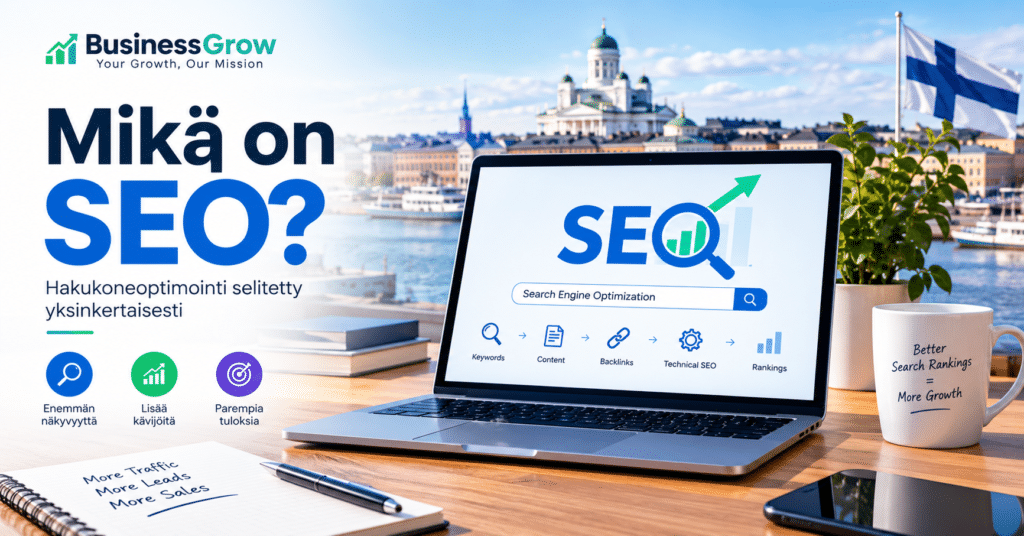
Mikä on SEO? is the Finnish way of asking “What is SEO?” And the short answer is simple: SEO, or search engine optimization, is the practice of improving a website so that search engines like Google can find it, understand it and show it higher in the results when people search for related topics. The goal is to earn more free, targeted visitors, also called organic traffic, without paying for every click.
If you have ever typed a question into Google and clicked one of the first few results, you have already seen SEO working. Somebody made that page easy to find, useful to read and trustworthy enough to rank. This guide explains exactly how that happens, in plain language, so that whether you own a small shop, run a service business or are just starting a career in digital marketing, you will know what SEO is, why it matters and how to start.
SEO is the process of optimizing your website’s content, technical setup and reputation so search engines rank it higher for the searches your customers make. It has three core pillars: on-page SEO (content and page elements), technical SEO (crawling, speed and structure) and off-page SEO (links and authority). It usually takes three to six months to see meaningful results, and it keeps paying off long after the work is done.
Want expert help instead of doing it alone?
Explore Our Organic SEO Services
What Is SEO? A Clear Definition
SEO stands for search engine optimization. It is the ongoing process of making a website more visible in unpaid, or “organic,” search results. When a person searches on Google, Bing or another search engine, the engine looks through billions of pages and decides which ones best answer the question. SEO is the work you do so that your page is one of the pages chosen.
A helpful way to think about it: a search engine is like a very fast librarian. It reads every book (web page), files each one by topic, and when somebody asks a question it hands over the books that seem most helpful and most reliable. SEO is how you make sure your book is well written, correctly labelled and recommended by other trusted sources.
SEO is different from paid advertising. With paid search ads, you pay each time someone clicks, and the traffic stops the moment you stop paying. With SEO, you invest in your website’s quality, and the results can continue for months or years. That is why many businesses treat SEO as a long-term asset rather than a monthly expense.
SEO covers a wide range of activities, including:
- Researching the words and questions your customers use
- Writing helpful, accurate and well-structured content
- Improving page titles, headings and descriptions
- Making the website fast, secure and mobile friendly
- Fixing technical errors that stop search engines from reading your pages
- Earning links and mentions from other reputable websites
- Managing your business profile for local searches
- Measuring results and improving over time
Mikä on SEOS? The Meaning Behind the Term
The phrase “mikä on SEO“ comes from Finnish, where mikä on means “what is.” Finnish searchers commonly use it when they want a beginner-friendly explanation of search engine optimization. In Finland, as in every other market, the word SEO is used in its English form, “SEO,” and the idea behind it is exactly the same everywhere: helping the right people discover your website through search.
This matters for two reasons. First, it shows how universal the concept is. Whether someone searches “mikä on SEO,” “what is SEO” or “qu’est-ce que le SEO,” they want the same thing: a clear explanation of how to be found online. Second, it shows why businesses in every country compete for search visibility. Search engines work on the same principles worldwide, so the strategies in this guide apply whether your customers are in Helsinki, Dhaka, Houston, Toronto or London.
If you are targeting an international or multilingual audience, remember that each language has its own search habits. Good SEO respects the language, culture and intent of the searcher, rather than simply translating keywords word for word.
Why Is SEO Important for Your Business?
Search is where buying journeys begin. People look for products, compare services, read reviews and ask questions through search engines every day. If your business does not appear when they search, they will find your competitors instead. Here is why SEO deserves a place in nearly every marketing plan.
SEO brings qualified, high-intent traffic
Someone who searches “affordable local SEO services” is already looking for a solution. SEO places your page in front of people at exactly that moment, which is why organic visitors often convert better than visitors who see a generic advert.
SEO builds long-term value
A well-optimized page can keep attracting visitors for years. Unlike a paid campaign that ends when the budget ends, strong content and a healthy website continue to work in the background.
SEO builds trust and credibility
Users tend to trust websites that appear naturally in search results. Ranking well signals that search engines consider your site relevant and reliable, and that reputation carries over to your brand.
SEO is cost effective
Because you are not paying per click, the cost per visitor generally falls over time as your rankings grow. That makes SEO one of the most sustainable ways to grow traffic, especially for small and medium businesses.
If your business needs professional support to reach these benefits faster, Business Grow’s SEO team can build a strategy around your goals, budget and market.
How Does SEO Work? Crawling, Indexing and Ranking
To understand SEO, it helps to understand what a search engine actually does. The process has three main stages.
Stage 1: Crawling
Search engines use automated programs, often called crawlers or bots, to discover pages. A crawler follows links from one page to another, collecting information along the way. If your website has broken links, blocked pages or a confusing structure, crawlers may miss important content.
Stage 2: Indexing
After crawling a page, the search engine tries to understand what it is about and stores it in a huge database called the index. It looks at the text, headings, images, links and other signals. If a page is not indexed, it cannot appear in search results at all, no matter how good it is.
Stage 3: Ranking
When someone enters a search, the engine checks its index and ranks the pages it believes best match the query. Hundreds of signals are considered, including relevance, content quality, the reputation of the site, page experience and the searcher’s context, such as location and language.
SEO works by helping you at every stage: making pages easy to crawl, clear to index and strong enough to rank. This is why a complete SEO strategy always combines content, technical health and authority.
To find out how your own website performs at each stage, a professional SEO audit is the best starting point. It reveals crawling errors, indexing gaps, slow pages and content opportunities in one clear report.
The Main Types of SEO
SEO is not one single task. It is a group of related disciplines that work together. Understanding each type helps you decide where to focus first.
On-Page SEO
On-page SEO covers everything you control directly on your web pages. It includes the quality and relevance of your content, and the elements that help search engines understand it.
Key on-page elements include:
- Title tags: The clickable headline shown in search results. It should include your main keyword and describe the page accurately.
- Meta descriptions: A short summary under the title. It does not directly boost rankings, but a good one improves clicks.
- Headings (H1, H2, H3): They organize your content and make it easy to scan.
- Content quality: Pages should answer the searcher’s question completely, clearly and honestly.
- Internal links: Links between your own pages help visitors and crawlers move around your site.
- Image optimization: Descriptive file names, alt text and compressed sizes.
- URL structure: Short, readable URLs that describe the page.
On-page SEO is usually the fastest place to see improvement because everything is in your hands. Learn more about how professional teams handle it on our organic SEO services page.
Technical SEO
Technical SEO is about the foundations of your website. Even great content will struggle if the site is slow, insecure or difficult for search engines to crawl.
Important technical areas include:
- Site speed and Core Web Vitals: Fast-loading, stable pages improve both rankings and user satisfaction.
- Mobile friendliness: Most searches now happen on phones, so your site must work well on small screens.
- HTTPS security: A secure connection is a basic trust signal.
- XML sitemaps and robots.txt: These files guide crawlers to the right pages.
- Structured data (schema markup): Extra code that helps search engines understand your content and can unlock rich results.
- Fixing errors: Broken links, redirect chains, duplicate content and crawl errors.
Technical problems are often invisible to owners but very visible to search engines, which is why a technical review is so valuable.
Off-Page SEO
Off-page SEO refers to actions taken outside your website that build your authority and reputation. The most important off-page signal is backlinks: links from other websites to yours. When respected sites link to you, search engines see it as a vote of confidence.
Other off-page signals include brand mentions, digital PR, social visibility, reviews and partnerships. Quality matters far more than quantity. A few links from relevant, trusted websites are worth much more than hundreds of low-quality ones, and spammy link building can lead to penalties.
Local SEO
Local SEO helps businesses appear when people search for services near them, such as “dentist near me” or “coffee shop in my city.” It focuses on your Google Business Profile, consistent name, address and phone details across the web, local citations, customer reviews and location-based content.
If you serve customers in a particular city or region, local SEO can be one of the highest-return investments you make. You can read more about it on our local SEO services page.
Ecommerce SEO
Ecommerce SEO is SEO tailored to online stores. It involves optimizing product pages, category pages, product descriptions, site structure, page speed and structured data so that products appear in search results and turn visitors into buyers. Online stores face special challenges such as duplicate product content, faceted navigation and thousands of URLs, so they need specific strategies.
Whether you use Shopify, WooCommerce, Magento or another platform, our ecommerce SEO services are designed to help you rank products and grow sales.
➡ Grow Your Online Store with Ecommerce SEO
Content SEO
Content SEO is the practice of creating articles, guides, videos and resources that answer real questions. Strong content earns rankings, attracts links and builds trust. It is the engine that powers most other SEO efforts, because every keyword you want to rank for needs a page that deserves to rank.
Summary Table: Types of SEO at a Glance
| Type of SEO | What It Focuses On | Example Actions |
|---|---|---|
| On-page SEO | Content and page elements | Titles, headings, internal links, content quality |
| Technical SEO | Website infrastructure | Speed, mobile usability, sitemaps, schema, crawl errors |
| Off-page SEO | Authority and reputation | Backlinks, brand mentions, digital PR |
| Local SEO | Searches near a location | Google Business Profile, citations, reviews |
| Ecommerce SEO | Online store visibility | Product pages, category pages, structured data |
| Content SEO | Helpful, ranking content | Blog posts, guides, FAQs, resources |
Key SEO Ranking Factors
Search engines do not publish their full formula, and it changes regularly. However, experience and Google’s own guidance point to several factors that consistently matter.
Helpful, people-first content
Google repeatedly states that it wants to reward content created to help people rather than to manipulate rankings. Pages should demonstrate real experience, expertise and honesty. This idea is often summarized as E-E-A-T: Experience, Expertise, Authoritativeness and Trustworthiness.
Search intent match
A page ranks well when it delivers what the searcher actually wants. If people searching a keyword want a step-by-step guide, a sales page will not perform well, and vice versa.
Backlinks and authority
Links from trusted, relevant websites remain one of the strongest signals of credibility.
Page experience
Speed, mobile usability, security and a clean layout without intrusive pop-ups all contribute to how users experience your site.
Site structure and internal linking
A logical structure helps crawlers find every important page and understand how topics relate.
SEO and Google AI Overviews
Search is changing. Google now shows AI Overviews for many queries: short, AI-generated summaries that appear above traditional results and cite sources. Other platforms, including chat assistants, also answer questions directly. This has led many people to ask whether SEO is still worth doing.
The answer is yes, and it matters more than ever. AI-powered search features rely on high-quality web content to build their answers. Pages that are clear, accurate, well structured and trustworthy are the pages most likely to be used and cited. In other words, the fundamentals of SEO are also the fundamentals of being visible in AI-driven search.
How to make your content AI-Overview friendly
- Answer the question directly, early. Put a clear, concise answer at the top of the page, just as this guide does, then expand with detail.
- Use question-style headings. Headings like “How does SEO work?” match how people and AI systems phrase queries.
- Keep paragraphs short and focused. Each section should cover one idea clearly.
- Use lists, steps and tables. They make information easy to extract and summarize.
- Add an FAQ section. Direct question-and-answer pairs are easy for search systems to understand.
- Show real expertise. Include accurate facts, original insights and clear authorship or company information.
- Use structured data where appropriate. Schema markup helps machines interpret your content.
- Keep your site technically healthy. Pages that cannot be crawled or indexed cannot be cited.
- Build brand authority. Mentions and links from trusted sources strengthen your credibility.
Some people call this approach generative engine optimization, or GEO. In practice it is simply good SEO, applied with extra attention to clarity, structure and trust. A modern SEO service should prepare your website for both traditional rankings and AI-driven answers, and that is the approach we take in our SEO services.
Keyword Research and Search Intent
Keywords are the words and phrases people type into search engines. Keyword research is the process of discovering which terms your audience uses, how often they search for them and how difficult it is to rank for them.
Types of keywords
- Short-tail keywords: Broad terms such as “SEO.” They have high volume but high competition and unclear intent.
- Long-tail keywords: Specific phrases such as “SEO services for small ecommerce stores.” They have lower volume but higher conversion potential.
- Question keywords: Phrases such as “mikä on SEO” or “how does SEO work,” which are ideal for informational content and AI Overviews.
- Local keywords: Terms that include a place, such as “SEO agency in Dhaka.”
Understanding search intent
Every search has an intent, meaning the reason behind it. The four common types are:
- Informational: The person wants to learn (“what is SEO”).
- Navigational: The person wants a specific site or brand.
- Commercial investigation: The person is comparing options (“best SEO agencies”).
- Transactional: The person is ready to act (“buy SEO package,” “hire SEO consultant”).
Matching your page to intent is essential. A beginner’s guide should educate; a service page should persuade and make it easy to take action.
How to Start SEO: A Step-by-Step Plan
If you are new to SEO, follow this practical roadmap.
Step 1: Set clear goals
Decide what success looks like. It might be more leads, more online orders, more phone calls or more brand awareness. Clear goals shape every later decision.
Step 2: Audit your current website
Check how your site performs today. Look at speed, mobile usability, indexing status, broken links, duplicate content and your current rankings. A professional SEO audit will save time by prioritizing the most important fixes.
Step 3: Research your audience and competitors
Find out who your customers are, what they search for and which competitors already rank. Look for gaps where you can provide better or more useful content.
Step 4: Build a keyword map
List your target keywords and match each one to a specific page. Avoid targeting the same keyword with multiple pages, which can cause internal competition.
Step 5: Fix technical foundations
Make sure your website is secure, mobile friendly, fast and easy to crawl. Submit an XML sitemap through Google Search Console and fix errors as they appear.
Step 6: Optimize your on-page elements
Write clear titles and descriptions, use headings properly, add helpful internal links, and make sure every page satisfies its target intent.
Step 7: Create high-quality content
Publish content that genuinely helps your audience. Use real examples, accurate information and a clear structure. Refresh older pages when information changes.
Step 8: Build authority
Earn links and mentions by creating resources worth sharing, collaborating with relevant partners, and promoting your work. Avoid shortcuts such as buying links, which can harm your site.
Step 9: Optimize for local search if relevant
Claim and complete your Google Business Profile, keep business details consistent everywhere, and encourage genuine customer reviews. Our local SEO team can help if you serve a specific area.
Step 10: Measure, learn and improve
Track organic traffic, keyword rankings, click-through rates, conversions and technical health using Google Analytics and Google Search Console. SEO is never finished; the best results come from steady, data-informed improvement.
Not sure where to begin? Let an expert team build your roadmap.
Common SEO Mistakes to Avoid
Even well-intentioned businesses make errors that slow their progress. Watch out for these.
- Ignoring search intent. Creating content that does not match what searchers want.
- Keyword stuffing. Repeating a phrase unnaturally. Modern search engines reward natural writing.
- Thin or copied content. Pages with little value or duplicated text rarely rank.
- Neglecting mobile users and speed. A slow or hard-to-use site loses visitors and rankings.
- Buying low-quality links. Cheap link packages can trigger penalties and waste money.
- Expecting overnight results. SEO takes time, and promises of first-page rankings in days deserve suspicion.
How Long Does SEO Take and What Does It Cost?
How long does SEO take?
There is no fixed timeline, because results depend on competition, website age, content quality and the amount of work done. As a general guide, many websites begin to see early improvements within three to six months, with stronger and more stable growth over six to twelve months. Highly competitive industries can take longer. Small local businesses with less competition can sometimes move faster.
Anyone who guarantees a specific ranking by a specific date is making a promise no one can honestly keep, because search engines are independent and constantly changing.
How much does SEO cost?
SEO costs vary widely by provider, location and scope. Prices generally depend on the number of keywords, the size of the website, the level of competition and how much content and link building is included. Monthly retainers are common because SEO is ongoing work.
At Business Grow, our monthly SEO plans are structured to fit different stages of growth:
| Plan | Price | What It Includes |
|---|---|---|
| Starter | $399 per month | Up to 15 keywords, basic on-page optimization, basic technical SEO, 1 blog topic per month |
| Bronze | $599 per month | Up to 30 keywords, strong on-page optimization, technical SEO fixes, 2 blog topics per month |
| Golden | $799 per month | Up to 50 to 100 keywords, full advanced on-page optimization, full site audit and indexing optimization, content calendar and blog guidance |
You can review the full details on our pricing page and choose the plan that suits your goals.
DIY SEO vs Hiring an SEO Agency
Should you handle SEO yourself or hire professionals? Both approaches can work, depending on your time, budget and skills.
DIY SEO suits small websites, low-competition markets and owners who enjoy learning and testing. An agency makes more sense when you are short on time or technical knowledge, work in a competitive industry, run a large site such as an online store, or have seen your own efforts stall. A good agency acts as an extension of your team, bringing tools, experience and a proven process.
How to choose the right SEO partner
Look for a provider that:
- Explains its process clearly and honestly
- Shares transparent reporting and realistic expectations
- Focuses on sustainable, white-hat methods
- Offers services that match your needs, such as organic SEO, local SEO or ecommerce SEO
- Can show relevant experience and be reached easily
Business Grow is a full-service digital agency working with clients internationally, offering SEO alongside digital marketing and web solutions. You can learn more about our team or browse our SEO work and portfolio to see how we approach projects.
Frequently Asked Questions About SEO
What does “mikä on SEO” mean?
“Mikä on SEO” is Finnish for “What is SEO?” It refers to search engine optimization, the practice of improving a website so it ranks higher in search engines and attracts more organic traffic.
What is SEO in simple words?
SEO is the process of making your website easier for search engines to find and understand, and more useful for visitors, so that it appears higher when people search for topics related to your business.
Is SEO free?
Appearing in organic search results is free, because you do not pay Google for each click. However, SEO requires time, skill and often tools or professional help. The investment is in the work, not in ad spend.
What are the three main types of SEO?
The three core types are on-page SEO (content and page elements), technical SEO (site infrastructure and performance) and off-page SEO (links, mentions and authority). Local SEO, ecommerce SEO and content SEO build on these foundations.
How long does it take for SEO to work?
Most websites see early signs of progress within three to six months, with stronger results over six to twelve months. The exact timeline depends on competition, site quality and the amount of consistent work done.
Is SEO still worth it with AI Overviews?
Yes. AI-powered search features draw on trustworthy, well-structured web content. Strong SEO helps your pages get found, understood and cited, both in traditional results and in AI-generated summaries.
What is the difference between SEO and paid ads?
SEO earns unpaid rankings through optimization and can deliver lasting traffic. Paid ads place your message at the top of results for a fee per click or impression, and the traffic ends when the budget ends. Many businesses use both together.
Can I do SEO myself?
Yes, especially for small sites. Start with the basics in this guide: keyword research, quality content, on-page optimization and technical health. If you need faster or more advanced results, an agency can help.
What is local SEO?
Local SEO is the practice of optimizing your online presence to appear in searches tied to a location, such as “near me” queries and Google Maps results. It is essential for businesses that serve customers in a specific area.
How do I know if my SEO is working?
Track organic traffic, keyword rankings, impressions, clicks, leads and sales using Google Search Console and Google Analytics. Steady growth in these areas over time shows your SEO is working.
Final Thoughts
So, mikä on SEO? It is the discipline of helping search engines and people find, understand and trust your website. It combines great content, a technically healthy site and a strong reputation, and it rewards patience, quality and consistency. As search evolves to include AI Overviews and conversational answers, the businesses that win will be the ones that publish clear, accurate, genuinely helpful information and back it with solid technical foundations.
You do not have to figure it all out alone. Whether you need a full audit, a local strategy, help ranking an online store or an ongoing organic SEO partner, the Business Grow team is ready to help you build visibility that lasts.
Ready to grow your rankings, traffic and revenue?
➡ Get Started with Organic SEO Services