
Homogeeninen Seos (Homogeneous Mixture): Definition, Properties, Examples and Separation Methods
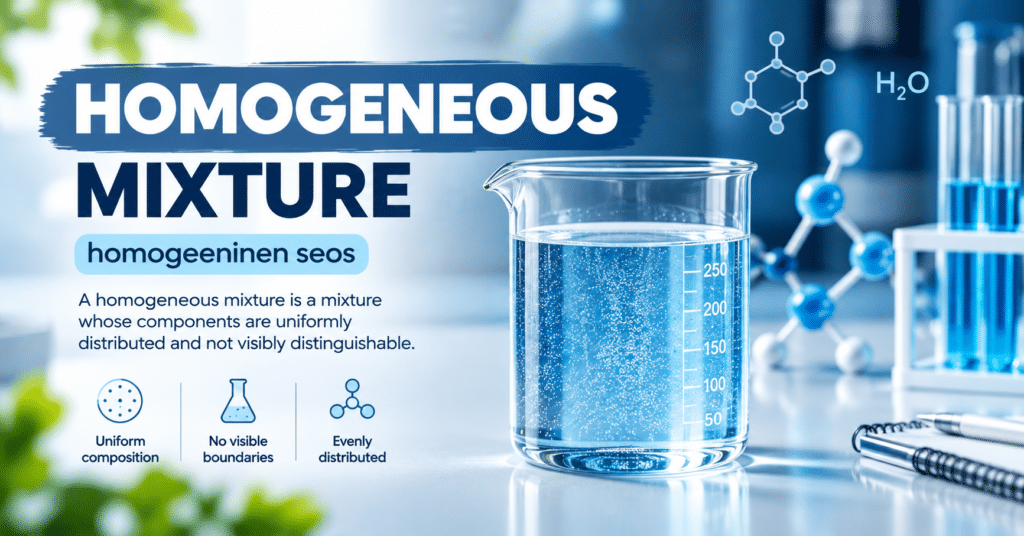
Homogeeninen seos is the Finnish term for a homogeneous mixture: a combination of two or more substances that is completely uniform throughout. Every sample you take, whether a spoonful or a litre, has the same composition and the same properties. You cannot see the separate ingredients, and you cannot filter them apart.
Salt water, air, brass, vinegar and a cup of black coffee are all examples of a homogeneous mixture. This guide explains what makes a mixture homogeneous, how it differs from a heterogeneous one, the main types, how solubility and concentration work, and which separation methods actually work. Near the end you will also find a short, practical section on how the same “uniform blend” idea applies to building a consistent SEO strategy.
What Is a Homogeneous Mixture?
A homogeneous mixture is a physical mixture of two or more substances that exists in a single phase and has uniform composition at every point. The particles of each component are mixed at the molecular, atomic or ionic level, so the mixture looks like one substance even though it is not a pure substance.
In Finnish chemistry, the same idea is expressed with a few related words:
| Finnish term | English meaning | Notes |
|---|---|---|
| homogeeninen seos | homogeneous mixture | Uniform throughout, single phase |
| heterogeeninen seos | heterogeneous mixture | Visibly different parts or phases |
| liuos | solution | The most common kind of homogeneous mixture |
| metalliseos | alloy | A homogeneous mixture of metals (a solid solution) |
| puhdas aine | pure substance | One element or one compound only |
| seos | mixture | General word for a blend of substances |
Key Takeaways
- A homogeneous mixture has the same composition throughout and appears as one phase.
- Most homogeneous mixtures are solutions, but gases and alloys count too.
- The components are not chemically bonded to each other, so each keeps its own chemical identity.
- The ratio of components can vary from sample to sample (unlike a compound, which has a fixed ratio).
- Components can be separated by physical methods such as evaporation, distillation or chromatography, not by simple filtering.
- Colloids such as milk look uniform but are usually classed as heterogeneous because their particles are larger and scatter light.
What Makes a Mixture Homogeneous?
To understand a homogeneous mixture, it helps to start with the word “mixture” itself. A mixture is a material made of two or more substances that are physically combined but not chemically bonded. Because no new chemical bonds form between the components, each substance keeps its own properties, and the proportions can change freely.
“Homogeneous” adds one more condition: the blend must be uniform. If you could look at a sample under a very powerful microscope and see the same distribution of particles everywhere, you are dealing with a homogeneous mixture.
The Five Core Characteristics
- Uniform composition. Any two samples taken from different parts of the mixture contain the same proportion of each component.
- Single phase. The whole mixture is solid, liquid or gas. You do not see layers, bubbles, clumps or settled particles.
- Particle size at the molecular scale. In a true solution, dissolved particles are typically smaller than about 1 nanometre, which is why they cannot be seen or filtered out.
- No settling. Particles stay evenly distributed over time. Gravity does not pull them to the bottom.
- Transparent or evenly coloured. A solution may be coloured, like copper sulfate in water, but it is clear and not cloudy. A beam of light passes through without being visibly scattered.
What Happens at the Particle Level?
When sugar dissolves in water, the crystal lattice breaks apart and individual sugar molecules become surrounded by water molecules. The sugar has not disappeared and it has not become a new compound. It has simply spread out evenly among the water molecules. If you evaporate the water, the sugar returns in its original form. This reversibility through physical means is a defining feature of mixtures.
Is a Homogeneous Mixture the Same as a Solution?
Not exactly. Every solution is a homogeneous mixture, but the phrase “homogeneous mixture” is a little broader in everyday use because it includes gas blends such as air and solid blends such as alloys. In practice, chemists often use “solution” and “homogeneous mixture” almost interchangeably when talking about liquids.
Homogeneous vs Heterogeneous Mixtures
The easiest way to separate these two ideas is to ask one question: Can I see more than one part or phase? If yes, the mixture is heterogeneous. If no, it is homogeneous.
| Feature | Homogeneous mixture | Heterogeneous mixture |
|---|---|---|
| Composition | Uniform throughout | Varies from place to place |
| Number of phases | One | Two or more |
| Visible components | No | Often yes |
| Particle size | Molecular or atomic scale | Larger than about 1,000 nm in suspensions |
| Settling over time | No | Often yes (suspensions) |
| Can be filtered | No | Often yes |
| Scatters a light beam | No (true solution) | Yes (colloids and suspensions) |
| Examples | Salt water, air, brass, vinegar | Sand and water, salad, oil and vinegar, granite |
The Grey Zone: Colloids and Suspensions
Two special categories cause most of the confusion.
Suspensions contain particles large enough to settle. Muddy water is a classic example. If you leave it alone, the dirt sinks. If you pour it through filter paper, the dirt stays behind. Suspensions are clearly heterogeneous.
Colloids sit between solutions and suspensions. Their particles are roughly 1 to 1,000 nanometres across, which is too small to settle quickly or be caught by ordinary filter paper, but large enough to scatter light. This scattering is called the Tyndall effect, and it is why a flashlight beam is visible in fog or in a glass of milk, but not in a glass of salt water.
Milk, fog, mayonnaise, whipped cream and gelatin all appear uniform to the naked eye. However, because they contain distinct dispersed particles in a continuous medium, most textbooks classify colloids as heterogeneous at the microscopic level. Some introductory courses call them “apparently homogeneous“, so it is wise to check which convention your teacher or exam board uses.
Types of Homogeneous Mixtures
Homogeneous mixtures can be grouped by the physical state of the solute (the substance being dissolved) and the solvent (the substance doing the dissolving, usually the one present in the larger amount).
| Solute | Solvent | Resulting state | Example |
|---|---|---|---|
| Solid | Liquid | Liquid | Salt in water, sugar in tea |
| Liquid | Liquid | Liquid | Ethanol in water, vinegar |
| Gas | Liquid | Liquid | Carbon dioxide in soda water |
| Gas | Gas | Gas | Air (nitrogen, oxygen, argon and others) |
| Solid | Solid | Solid | Brass, bronze, steel (alloys) |
| Gas | Solid | Solid | Hydrogen absorbed in palladium |
| Liquid | Solid | Solid | Mercury dissolved in gold (amalgam) |
1. Solid-in-Liquid Solutions
This is the type most people meet first in school. Table salt, sugar, baking soda and copper sulfate all dissolve in water to form clear solutions. The solid breaks into ions or molecules that disperse evenly through the liquid.
2. Liquid-in-Liquid Solutions
Liquids that mix completely are called miscible. Ethanol and water are miscible in any proportion. Vinegar is a solution of acetic acid in water, usually around 5 percent acetic acid for household use. Liquids that do not mix, such as oil and water, are immiscible and form a heterogeneous mixture.
3. Gas-in-Liquid Solutions
Fizzy drinks hold carbon dioxide under pressure. Rivers and oceans contain dissolved oxygen that fish use to breathe. These solutions follow Henry’s law, which says that, at a constant temperature, the amount of dissolved gas is proportional to the pressure of that gas above the liquid. When you open a soda bottle, the pressure drops and the gas leaves the solution as bubbles.
4. Gas Mixtures
Air is the most important homogeneous mixture on Earth. Dry air is roughly 78 percent nitrogen, 21 percent oxygen, about 0.9 percent argon and around 0.04 percent carbon dioxide, with trace amounts of neon, helium, methane and other gases. Because gas molecules move freely and mix completely, any gas mixture in a closed container becomes homogeneous.
5. Solid Solutions and Alloys
An alloy is a homogeneous mixture of a metal with one or more other elements. The atoms of the second element sit inside or between the atoms of the base metal. Examples include:
- Brass: copper and zinc
- Bronze: copper and tin
- Steel: iron with a small amount of carbon
- Sterling silver: 92.5 percent silver, usually alloyed with copper
- Stainless steel: iron with chromium and often nickel
Alloys are called metalliseos in Finnish, and they are a perfect example of how a homogeneous mixture can be solid.
Everyday Examples of Homogeneous Mixtures
Once you know what to look for, you will see homogeneous mixtures everywhere. Here are examples sorted by where you are likely to find them.
In the Kitchen
- Sugar or salt dissolved in water
- Black coffee or tea without particles
- Clear fruit juice that has been filtered
- White vinegar
- Cooking oil (a blend of different fats that is uniform in appearance)
- Honey (a concentrated sugar solution with minor components)
- Clear soda water
In the Home and Garden
- Tap water with dissolved minerals
- Rubbing alcohol, commonly sold as 70 percent isopropyl alcohol in water
- Window cleaning solution
- Air inside the house
- Brass door handles and bronze decorations
- Stainless steel cutlery
In Medicine and Health
- Normal saline solution, which is 0.9 percent sodium chloride in water
- Many liquid medicines in which the active ingredient is fully dissolved
- Medical oxygen mixed with air
- Alloys used in dental fillings and orthopaedic implants
In Nature
- The atmosphere
- Seawater, which averages about 35 grams of dissolved salts per kilogram of water
- Natural gas, a mix of methane with smaller amounts of ethane, propane and other gases
- Mineral water from springs
Examples That Are Often Misclassified
| Material | Looks uniform? | Actual classification | Why |
|---|---|---|---|
| Milk | Yes | Colloid (heterogeneous) | Fat droplets are dispersed in water and scatter light |
| Orange juice with pulp | No | Heterogeneous | Visible pulp particles |
| Mayonnaise | Yes | Colloid (emulsion) | Oil droplets suspended in water-based liquid |
| Fog | Yes | Colloid (aerosol) | Tiny water droplets in air |
| Blood | Yes | Heterogeneous | Cells suspended in plasma |
| Muddy water | No | Suspension | Particles settle with time |
| Tap water | Yes | Homogeneous (dilute solution) | Dissolved minerals only |
Homogeneous Mixture vs Pure Substance vs Compound
Many learners mix up these three terms because all three can look uniform. The differences become clear when you compare them side by side.
| Property | Pure element | Compound | Homogeneous mixture |
|---|---|---|---|
| Number of substances | One | One (made of several elements) | Two or more |
| Chemical bonds between components | Not applicable | Yes, fixed bonds | No new bonds |
| Composition | Fixed | Fixed ratio by mass | Variable ratio |
| Separation | Cannot be separated chemically | Chemical reaction required | Physical methods |
| Melting or boiling point | Sharp, constant | Sharp, constant | Often a range |
| Example | Oxygen, gold | Water, carbon dioxide | Salt water, air |
A useful check is the fixed ratio test. Water is always two hydrogen atoms for every oxygen atom. Salt water, however, can contain a little salt or a lot of salt, and it is still salt water. Variable composition is the signature of a mixture.
How Solubility Controls Homogeneous Mixtures
Whether two substances form a homogeneous mixture depends largely on solubility, which is the maximum amount of solute that dissolves in a given amount of solvent at a given temperature.
“Like Dissolves Like”
This is the most reliable rule of thumb in chemistry. Polar solvents, such as water, dissolve polar and ionic solutes, such as salt and sugar. Non-polar solvents, such as hexane, dissolve non-polar solutes, such as fats and oils. This is why oil and water refuse to form a homogeneous mixture: their molecules interact very differently.
Saturated, Unsaturated and Supersaturated
- Unsaturated: more solute can still dissolve at that temperature.
- Saturated: the solution holds the maximum amount of solute possible. Any extra solute stays undissolved.
- Supersaturated: the solution temporarily holds more solute than normal, usually after being heated and then carefully cooled. It is unstable, and a tiny disturbance can trigger rapid crystallisation.
Factors That Affect Solubility
- Temperature. For most solids in water, solubility increases as temperature rises. That is why you can dissolve more sugar in hot tea than in iced tea. For gases, the opposite is true: warm soda goes flat faster because less gas stays dissolved.
- Pressure. Pressure has almost no effect on solids and liquids, but it strongly affects gases, as described by Henry’s law.
- Nature of solute and solvent. Polarity, molecular size and hydrogen bonding all matter.
- Stirring and particle size. These change how fast something dissolves, not how much dissolves in total.
How to Measure the Concentration of a Homogeneous Mixture
Because the proportions of a homogeneous mixture can vary, chemists need a standard way to describe how much solute is present. The most common methods are below.
Mass Percent
Mass percent = (mass of solute ÷ mass of solution) × 100
Example: You dissolve 10 g of sugar in 90 g of water. The total mass of solution is 100 g, so the mass percent of sugar is (10 ÷ 100) × 100 = 10 percent.
Molarity
Molarity (M) = moles of solute ÷ litres of solution
Example: The molar mass of sodium chloride is about 58.44 g/mol. Dissolving 58.44 g of NaCl in enough water to make 1.00 L of solution gives a 1.00 M solution.
Parts Per Million (ppm)
Parts per million is used for very dilute solutions such as drinking water or air pollutants. In dilute water solutions, 1 mg of solute per litre is approximately 1 ppm.
Volume Percent
Volume percent is common for liquid-in-liquid mixtures. A bottle labelled 40 percent alcohol by volume contains 40 mL of ethanol in every 100 mL of liquid.
Dilution
When you add more solvent to a solution, the amount of solute stays the same but the concentration drops. The dilution formula is:
M₁V₁ = M₂V₂
Example: To make 500 mL of 0.1 M solution from a 1.0 M stock, you need V₁ = (0.1 × 500) ÷ 1.0 = 50 mL of stock solution, then add water up to 500 mL.
How to Separate a Homogeneous Mixture
Because the particles in a homogeneous mixture are so small and evenly spread, you cannot pick them out by hand or filter them away. Instead, you use methods that take advantage of differences in physical properties like boiling point, solubility or attraction to a surface.
| Method | Works best for | Property used | Example |
|---|---|---|---|
| Evaporation | Dissolved solid in liquid | Solvent evaporates, solute stays | Getting salt from seawater |
| Simple distillation | Liquid solvent from dissolved solid | Boiling point | Making distilled water |
| Fractional distillation | Mixtures of liquids | Different boiling points | Separating ethanol from water, refining crude oil |
| Crystallisation | Solid from a hot saturated solution | Solubility changes with temperature | Producing sugar crystals |
| Chromatography | Dissolved substances with similar properties | Different attraction to a stationary phase | Separating ink dyes |
| Reverse osmosis | Salt or contaminants from water | Pressure and a semipermeable membrane | Desalination |
| Liquefaction of air | Gases in air | Different condensation temperatures | Producing oxygen and nitrogen |
1. Evaporation
Heat the solution until the solvent turns into vapour. The dissolved solid remains as a residue. This is how sea salt has been harvested for centuries. The method works only when you do not need to keep the solvent.
2. Simple Distillation
If you want to keep the solvent as well, you can boil the solution, collect the vapour, and cool it down so it condenses back into a liquid. This produces distilled water and leaves the dissolved solids behind.
3. Fractional Distillation
When two or more liquids are mixed, you can separate them if their boiling points differ enough. Ethanol boils at about 78.4 degrees Celsius, while water boils at 100 degrees Celsius. By heating the mixture and passing the vapour through a fractionating column, the more volatile ethanol is collected first. Note that ethanol and water form an azeotrope at about 95 percent ethanol, so ordinary distillation cannot push purity much beyond that point.
4. Crystallisation
Prepare a hot, nearly saturated solution and let it cool slowly. As solubility drops, the solute forms crystals that can be filtered and dried. The size and purity of crystals depend on how slowly the solution cools.
5. Chromatography
Chromatography separates substances because each one moves at a different speed through a stationary material. In paper chromatography, a spot of ink is placed near the bottom of a strip, and a solvent travels upward. Different dyes travel different distances, producing a pattern of bands. More advanced versions such as thin-layer, gas and liquid chromatography are used in laboratories for food safety, drug testing and environmental monitoring.
6. Reverse Osmosis
In normal osmosis, water moves across a membrane from a dilute solution to a concentrated one. Reverse osmosis applies pressure to push water in the opposite direction, leaving salts and many contaminants behind. It is widely used in desalination plants and home water purifiers.
What Does Not Work
Ordinary filtration does not separate a true solution, because dissolved particles pass straight through filter paper. If a filter does separate your mixture, it was not a true homogeneous mixture to begin with.
Why Homogeneous Mixtures Matter
In Industry
Manufacturers rely on uniform blends to keep products consistent. Alloys provide strength and corrosion resistance in construction, aviation and medical devices. Paints, cleaning products and fuels are formulated as stable solutions or carefully controlled mixtures so that every batch behaves the same way.
In Medicine
Intravenous fluids must be perfectly homogeneous so that each dose delivers exactly the right amount of active ingredient. Saline, glucose solutions and many liquid medicines are designed so that no part of the bottle is stronger or weaker than another.
In the Environment
The atmosphere’s composition affects climate and breathing. Dissolved oxygen levels in lakes and rivers determine whether aquatic life can survive. Monitoring the concentration of pollutants in air and water, often in parts per million or even parts per billion, is a core task in environmental science.
In Food and Drink
Brewing, cooking and baking all depend on controlling solutions. Sweetness, acidity and salinity are concentration questions. A cook who dissolves salt fully before pouring ensures that every portion tastes the same, which is the kitchen version of a homogeneous mixture.
Common Misconceptions About Homogeneous Mixtures
“If it looks clear, it must be homogeneous.” Not always. Some colloids and fine suspensions can look clear at first glance. A light beam test or a long wait for settling can reveal the truth.
“A homogeneous mixture is a pure substance.” It is not. Pure substances have a fixed composition. A mixture can be adjusted freely.
“Dissolving is a chemical reaction.” In most cases, dissolving is a physical change. Salt in water separates into ions but can be recovered by evaporation. There are exceptions, such as metals reacting with acids, where the metal does not simply dissolve but reacts to form a new compound.
“Air is a compound.” Air is a mixture, because its components are not chemically bonded and their proportions can change.
“Alloys are not mixtures because they are solid.” Alloys are mixtures, specifically solid solutions. The state of matter does not decide whether something is a mixture.
Quick Practice Questions
1. Is sweetened black tea a homogeneous or heterogeneous mixture?
Homogeneous, provided no leaf particles remain. Sugar and tea compounds are dissolved in water.
2. Is a bowl of cereal with milk homogeneous?
No. The solid cereal pieces are clearly separate from the liquid, so it is heterogeneous.
3. What type of mixture is brass?
Brass is a homogeneous mixture and a solid solution of copper and zinc.
4. How could you recover salt from salt water?
By evaporation. Heat the solution until the water is gone and the salt remains. If you also want pure water, use simple distillation.
5. A solution contains 20 g of sugar in 180 g of water. What is its mass percent?
The total mass is 200 g, so the mass percent is (20 ÷ 200) × 100 = 10 percent.
From Chemistry to Strategy: What a “Homogeneous” Approach Means for SEO
The idea behind a homogeneous mixture is simple: every part of the blend should be consistent with every other part. That same principle applies to search engine optimisation, and it is one of the most overlooked reasons websites struggle to rank.
If a site has strong content on some pages but weak technical performance, inconsistent business details across directories, or a design that does not support conversions, search engines receive mixed signals and visitors leave. A homogeneous SEO strategy blends all the key ingredients so evenly that no single weakness drags the rest down.
Business Grow is a full-service digital agency that works across all of these areas. Here is how each ingredient fits together, with the matching service for each.
Ingredient 1: Organic SEO Foundations
On-page optimisation, off-page authority building and technical health are the base of any lasting ranking strategy. On-page work aligns your content with user intent, off-page work builds trust through backlinks and brand mentions, and technical work makes sure search engines can crawl, index and understand your pages quickly.
Ingredient 2: A Full SEO Audit
Before you can blend anything evenly, you need to know what is in the mix. An SEO audit reviews page speed, mobile usability, Core Web Vitals, crawl errors, indexing, on-page elements and content gaps, then turns the findings into a prioritised action list.
Ingredient 3: Local SEO Consistency
For businesses that serve a city or region, consistency is everything. Your Google Business Profile, directory listings and website must show identical name, address and phone details. Local SEO also covers review management, location pages and local link building so you appear in map results and “near me” searches.
Ingredient 4: E-Commerce SEO
Online stores have extra layers to manage: product titles, descriptions, category pages, structured data, faceted navigation and buying guides. E-commerce SEO makes sure those layers work together across platforms such as Shopify, WooCommerce, Magento and BigCommerce.
Ingredient 5: A Website Built to Perform
Even perfect content cannot rank if the site is slow, hard to use or not mobile friendly. A professionally developed website supports speed, security and conversions from the first click.
If you sell products online, a store designed around the shopping journey makes a visible difference to both user experience and sales.
Ingredient 6: Digital Marketing to Amplify Results
Organic SEO builds long-term traffic. Paid search and social campaigns add speed, testing data and retargeting on top. Google Ads, Facebook Ads, Facebook marketing and Instagram marketing can be planned so that paid and organic efforts support each other.
Ingredient 7: A Consistent Brand Identity
Logos, colours, social media assets and brand guidelines make every touchpoint feel like part of the same company. That consistency builds recognition and trust, which supports branded searches and repeat visits.
How to Know Which Ingredient You Need First
- If you are not sure where your site stands, start with an SEO audit.
- If your pages are fine but you are not ranking, focus on organic SEO content and authority.
- If your customers are nearby, prioritise local SEO.
- If you run an online shop, begin with e-commerce SEO and store design.
- If you want faster visibility while organic rankings grow, add digital marketing.
You can compare packages and monthly plans on the pricing page, or talk with the team directly to build a plan around your goals.
To learn more about the agency and the way it works, visit the About page, browse the Business Grow blog, or return to the Business Grow homepage.
Frequently Asked Questions About Homogeneous Mixtures
What does homogeeninen seos mean?
Homogeeninen seos is Finnish for “homogeneous mixture”. It describes a mixture whose composition and properties are the same in every part, such as salt water, air or brass.
What are 10 examples of homogeneous mixtures?
Salt water, sugar water, air, vinegar, brass, bronze, steel, rubbing alcohol, normal saline and carbonated water are all common examples.
Is a homogeneous mixture the same as a solution?
A solution is the most common type of homogeneous mixture, but the term “homogeneous mixture” also covers gas mixtures like air and solid mixtures like alloys.
How is a homogeneous mixture different from a heterogeneous mixture?
In a homogeneous mixture, the components are evenly distributed and you cannot see separate parts. In a heterogeneous mixture, you can see different phases or components, such as oil floating on water or pieces in a salad.
Can you separate a homogeneous mixture by filtering?
No. Dissolved particles are far smaller than the pores in filter paper. You need methods such as evaporation, distillation, crystallisation, chromatography or reverse osmosis.
Is milk a homogeneous mixture?
Milk looks uniform, but it is a colloid with fat droplets dispersed in water. Most chemistry sources classify it as heterogeneous, although some basic courses describe it as apparently homogeneous.
Is air a homogeneous mixture?
Yes. Clean, dry air is a uniform gas mixture of nitrogen, oxygen, argon, carbon dioxide and trace gases. Air with dust, smoke or clouds becomes heterogeneous.
Are alloys homogeneous mixtures?
Yes. Alloys such as brass and steel are solid solutions in which the atoms of the components are spread evenly through the metal.
Does a homogeneous mixture have a fixed composition?
No. The proportions can vary. A weak coffee and a strong coffee are both homogeneous mixtures of the same substances in different ratios.
What is the Tyndall effect and why does it matter?
The Tyndall effect is the scattering of light by particles in a colloid or suspension. If a light beam is visible as it passes through a liquid, the liquid is not a true solution.
Why is a homogeneous mixture not a pure substance?
Because it contains more than one substance that can be separated by physical means and because its composition is variable.
How does an SEO strategy relate to a homogeneous mixture?
It is an analogy. A strong SEO strategy blends content, technical health, local signals, design and brand identity so that the result is consistent, and no weak ingredient lowers overall performance.
Conclusion
A homogeneous mixture, or homogeeninen seos, is a uniform blend of two or more substances in a single phase. Its particles are mixed at the molecular level, its composition can vary, its components keep their own identities, and it can be separated only by physical methods such as evaporation, distillation, crystallisation, chromatography or reverse osmosis. From the air you breathe to the steel in a bridge, homogeneous mixtures are at the heart of chemistry, industry, medicine and daily life.
The same lesson applies to your online presence. The best results come when every element, from technical health and content to local signals, design and brand, is blended evenly. If you are ready to build a consistent, search-friendly website, the team at Business Grow can help you get there.