SEO Ylikiiminki: The Complete Local SEO Guide to Rank on Google and in AI Overviews
What Is SEO Ylikiiminki?
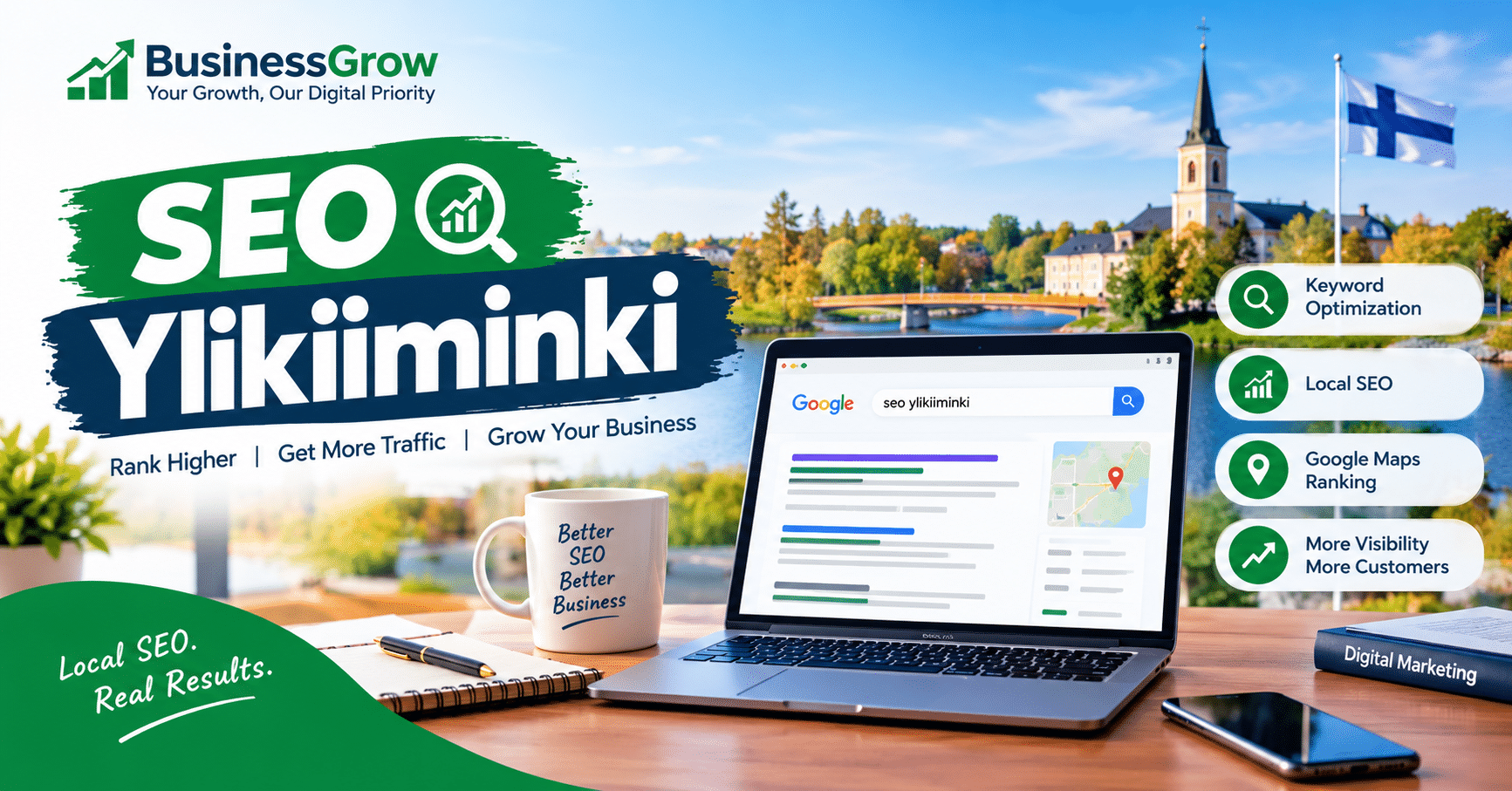
SEO Ylikiiminki means search engine optimization for businesses, entrepreneurs and organizations that serve customers in Ylikiiminki, a rural area in the Oulu region of Northern Ostrobothnia, Finland. It combines local SEO, Finnish-language keyword targeting, Google Business Profile optimization, technical website health and helpful content so that your business appears when people search for your products or services in Ylikiiminki, Kiiminki, Oulu and the surrounding area.
In short, SEO Ylikiiminki is about three things: being found by nearby customers, being trusted by Google and by AI-powered search features, and being chosen over competitors once the customer lands on your page.
Explore Our Organic SEO Services →
Why Local SEO Matters for Ylikiiminki Businesses
Ylikiiminki is not a high-volume search market, and that is exactly why local SEO works so well here. When a farm shop, contractor, accommodation provider, craftsperson, clinic or small manufacturer competes in a small area, even a handful of well-optimized pages can put you ahead of competitors who have not invested in search at all.
Think about how people in a rural area behave online. They search from their phones while commuting, comparing options before visiting, or looking for a service they need today. They type short, practical queries, often in Finnish, and they expect to see opening hours, a phone number, a map pin and recent reviews immediately. If your business is missing from those results, the customer simply calls the next name on the list.
Local SEO also protects you from a common problem: relying on word of mouth alone. Word of mouth is powerful in small communities, but it does not scale, and it does not reach new residents, seasonal visitors, remote workers, or people who have moved to the Oulu region and do not yet know who to trust. Search visibility fills that gap.
The business case in plain terms
- Lower acquisition cost. Organic visibility keeps working after the work is done, unlike advertising that stops when the budget stops.
- Higher intent traffic. A person searching for a local service is usually close to a decision.
- Stronger local reputation. Reviews, listings and consistent business information reinforce trust.
- Resilience. A healthy search presence reduces dependence on any single social platform or ad account.
Understanding Ylikiiminki as a Search Location
Ylikiiminki was formerly its own municipality and became part of the city of Oulu when the municipalities of Kiiminki and Ylikiiminki merged with Oulu at the start of 2013. Many residents still use the name Ylikiiminki in everyday speech, and many businesses still identify themselves with it. That matters for SEO, because search behavior does not always follow administrative borders.
A customer might search for any of the following:
- the village name on its own,
- the village name combined with a service,
- the neighboring Kiiminki area,
- the wider city name Oulu,
- or a “near me” style query that Google resolves by location.
A good local SEO plan therefore targets a cluster of place names, not just one. Your content should naturally mention Ylikiiminki, Kiiminki and Oulu where it is truthful and relevant, helping Google understand the geographic area you serve without sounding forced.
Search intent in a rural, Finnish-speaking market
Most local searches fall into one of four intent groups:
- Immediate need: “service near me,” opening hours, phone number, emergency or same-day help.
- Comparison: looking at several local providers, prices, reviews and photos.
- Information: how something works, what it costs, what to prepare before hiring.
- Navigation: looking for a specific business by name or address.
Your site and Google Business Profile should satisfy all four. Many small websites only cover navigation, which means they miss the comparison and information stages where new customers are won.
The Core Pillars of SEO Ylikiiminki
Effective local SEO rests on five connected pillars. Neglecting one weakens the others.
Pillar 1: Local keyword research
Keyword research for Ylikiiminki starts with how your real customers talk. Because the audience is primarily Finnish-speaking, you should research both Finnish and, where relevant, English terms. Tourists, international workers, students and companies dealing with foreign partners may search in English even when the business is local.
A practical keyword model combines three layers:
- Service or product term (what you sell or do),
- Location term (Ylikiiminki, Kiiminki, Oulu, Northern Ostrobothnia),
- Modifier (price, best, near me, open now, reviews, how to choose).
Group keywords by intent and map each group to a single page. One page should target one primary theme, which avoids pages competing against each other for the same query.
Tips for finding the right terms
- Use Google autocomplete and “People also ask” to see natural phrasing.
- Check related searches at the bottom of the results page.
- Review your Google Search Console queries for terms that already bring impressions.
- Look at what nearby competitors rank for and where their content is thin.
- Ask customers how they found you and which words they used.
Pillar 2: On-page optimization
On-page SEO tells Google exactly what each page is about and makes it easy for users to act.
- Title tags: include the primary keyword and location, keep them concise and make them compelling.
- Meta descriptions: write a clear benefit-driven summary that earns the click.
- Headings: use one H1 and logical H2 and H3 headings that mirror real questions.
- URL structure: short, readable and descriptive.
- Image optimization: compress images, use descriptive file names and meaningful alt text.
- Internal links: connect related pages so visitors and crawlers can move naturally between topics.
- Calls to action: make contact, booking or purchase paths obvious.
Pillar 3: Technical SEO
A site that is slow, insecure or hard to crawl cannot rank well, however good its content is. Core technical checks include:
- HTTPS across the entire site,
- fast loading on mobile networks, including slower rural connections,
- a responsive layout that works on small screens,
- clean crawlability with a correct XML sitemap and robots file,
- fixing broken links and redirect chains,
- structured data (schema markup) for local business information,
- good Core Web Vitals scores.
If you are unsure where your site stands, a professional SEO audit is the fastest way to identify what is holding your rankings back and which fixes deliver the biggest gains first.
Pillar 4: Content and topical authority
Google rewards websites that demonstrate real expertise on a topic. For a local business, that means publishing helpful content about the problems your customers actually face: buyer guides, pricing explanations, seasonal checklists, process explainers, case examples and answers to common questions.
Authority is built through depth and consistency, not volume alone. Ten genuinely useful pages that fully answer customer questions usually outperform fifty thin pages written only to catch keywords.
Pillar 5: Authority and trust signals
Trust is the quiet multiplier behind every ranking. It comes from:
- reviews that are recent, honest and detailed,
- consistent name, address and phone details across the web,
- mentions and links from local organizations, associations and news sites,
- clear contact information, an about page and visible business credentials,
- accurate, up-to-date content.
Google Business Profile: The Fastest Local Win
For most local businesses, the Google Business Profile (GBP) is the single most important asset after the website itself. It controls how you appear in Google Maps and the local pack, the map-based block of results that appears for many location searches.
How to optimize your Google Business Profile
- Claim and verify your listing so you control the information.
- Choose the right primary category, which has a strong influence on which searches you appear for, then add accurate secondary categories.
- Complete every field: address or service area, phone, website, hours, services, products and attributes.
- Write a clear business description that explains what you do, who you serve and where, using natural language.
- Add quality photos and short videos of your premises, team, products and finished work.
- Post updates regularly such as offers, events and news.
- Keep holiday and seasonal hours accurate, which is especially important in Finland where holiday schedules matter.
- Use the Q&A and messaging features to answer customer questions quickly.
Reviews that build trust and rankings
Reviews influence both ranking and conversion. Ask satisfied customers to leave a review soon after the job is done, while the experience is fresh. Make it easy by sharing a direct review link. Respond to every review, positive or negative, politely and specifically. Never buy fake reviews or offer inappropriate incentives, because that violates platform rules and can damage your visibility.
Businesses wanting hands-on help with listings, citations and map visibility can explore professional local SEO services built for exactly this purpose.
Local Citations and NAP Consistency
A citation is any online mention of your business name, address and phone number (NAP). Search engines compare these details across directories, maps, social profiles and websites to decide whether your business is real, active and reliable.
Best practices
- Use exactly the same business name, address format and phone number everywhere.
- List your business in respected general directories and in Finnish business and industry directories.
- Remove or merge duplicate listings.
- Update every listing when you move, rebrand or change hours.
- Make sure your website footer and contact page match your listings.
Small inconsistencies, such as one listing using an old phone number, can confuse search engines and reduce confidence in your data. For a rural area where fewer competitors maintain their listings carefully, tidy citations can be a real advantage.
Writing for Finnish Searchers Without Losing Clarity
Because Finnish is a heavily inflected language, the same concept can appear in many grammatical forms. Search engines handle this reasonably well, but your content should still read naturally in the language your customers use.
Practical language guidelines
- Write in natural Finnish for Finnish pages, with a human reviewer who is a native speaker if you are not one.
- Avoid translating word for word from English, which often produces unnatural phrasing.
- Use local terms that people really search with rather than formal textbook vocabulary.
- Offer English pages if you serve tourists, international workers or overseas partners, and connect language versions with proper hreflang tags so Google serves the right page to the right audience.
- Keep sentences clear and short so both people and AI systems can extract an answer easily.
If you target multiple languages, keep one clear URL per language version and avoid automatic translations without human review, which can reduce quality and trust.
How to Optimize for Google AI Overviews
Google AI Overviews are AI-generated summaries that appear above traditional results for many queries. They pull information from pages Google considers helpful, accurate and well structured, and they link to the sources they use. Appearing as a cited source can bring visibility even when users do not scroll far down the page.
No one can guarantee inclusion in an AI Overview, but you can make your content much easier to understand, trust and quote. The same fundamentals that help traditional rankings help here as well.
Techniques that improve your chances
1. Lead with a direct answer. Open each section with a short, factual answer of one or two sentences, then expand with detail. This mirrors the structure AI summaries prefer.
2. Use question-style headings. Headings such as “How much does X cost in Oulu?” or “How do I choose a provider?” match real queries and make extraction simple.
3. Keep paragraphs short and scannable. Short paragraphs, bullet lists, numbered steps and comparison tables help systems identify distinct facts.
4. Be specific and verifiable. Include concrete details such as service areas, process steps, timeframes, materials and conditions. Vague marketing language rarely gets quoted.
5. Demonstrate experience and expertise. Show who is behind the content, what experience they have and how you know what you are describing. Real photos, case examples and author information strengthen credibility.
6. Add structured data. Use LocalBusiness, Organization, FAQPage and other relevant schema types where appropriate to clarify what your content represents.
7. Keep information fresh. Update prices, hours, policies and key facts regularly, and show the last-updated date where it is meaningful.
8. Build a strong entity footprint. Make sure your business name, description and details are consistent across your website, Google Business Profile, social profiles and directories. Consistent signals help search systems recognize your business as a distinct, reliable entity.
9. Cover the full topic. Answer related follow-up questions on the same page or through well-linked supporting pages. Topic completeness signals authority.
10. Protect page quality. Fast loading, mobile-friendly design and a clean, uncluttered layout help both people and systems read your page.
An example of answer-first structure
Question: How long does local SEO take to show results?
Answer-first format: “Most local businesses begin to see early improvements in map visibility and impressions within a few weeks, while stronger ranking and enquiry growth typically develops over three to six months, depending on competition, website condition and consistency of work. Smaller, less competitive areas can move faster than large cities.”
Then continue with an explanation of the factors that influence timing. That structure serves the reader first and makes the key fact easy to cite.
A Step-by-Step SEO Plan for a Ylikiiminki Business
Here is a practical roadmap you can follow, whether you run the work yourself or hire an agency.
Step 1: Define your goals and service area
Decide what success means: phone calls, form submissions, bookings, shop visits or online orders. Then define the geographic area you realistically serve, naming Ylikiiminki, Kiiminki, Oulu and any other nearby places.
Step 2: Audit your current presence
Review your website, Google Business Profile, directory listings, reviews and competitors. Note technical errors, missing pages, outdated details and content gaps.
Step 3: Fix the technical foundation
Resolve speed problems, mobile issues, broken links, indexing errors and security warnings before investing heavily in new content.
Step 4: Build your keyword map
Assign each important keyword group to one page. Create new pages where gaps exist, such as separate pages for each distinct service.
Step 5: Optimize and expand your pages
Improve titles, descriptions, headings and copy. Add FAQs, pricing guidance, process explanations, photos and proof such as testimonials and examples.
Step 6: Optimize your Google Business Profile
Complete every section, choose accurate categories, upload fresh photos and begin a steady review-request routine.
Step 7: Clean up and build citations
Standardize NAP details and list your business in relevant directories and industry sites.
Step 8: Publish helpful content consistently
Create a content calendar around customer questions, seasonal needs and local topics. Publish steadily rather than in rare bursts.
Step 9: Earn local links and mentions
Work with local associations, suppliers, partners, events, schools, clubs and media. Relevant local links are valuable and often easier to earn in a small community than in a large city.
Step 10: Track, learn and improve
Monitor impressions, clicks, rankings, calls, direction requests and conversions. Review performance monthly, double down on what works and fix what does not.
Content Ideas That Work for Local Businesses in Ylikiiminki
Not sure what to publish? These formats consistently attract local searchers and are easy for AI systems to understand.
- Service pages with a clear explanation of what is included, who it suits, typical timelines and how to book.
- Location pages describing how you serve Ylikiiminki, Kiiminki and Oulu, with genuine local detail rather than copied text.
- Pricing and cost guides that explain what influences price.
- How-to and checklist content for seasonal needs, which in northern Finland often relate to long winters, short summers and changing weather conditions.
- Case studies showing the problem, your approach and the result.
- FAQ pages that answer the real questions customers ask by phone or email.
- Comparison content that helps people choose between options honestly.
- Local news and event posts that show your involvement in the community.
Content quality checklist
Before publishing, confirm that the page:
- answers a real question clearly in the first few lines,
- includes details only someone with real experience would know,
- is accurate, current and free of exaggerated claims,
- is easy to read on a phone,
- includes a clear next step for the reader,
- links to relevant pages on your own site.
Local SEO for E-Commerce and Online Shops in the Region
Some Ylikiiminki businesses sell beyond the village, such as handmade products, food, outdoor gear, crafts or specialist equipment. They need a different mix: strong product-level SEO with local trust signals as a bonus.
Key priorities include unique product descriptions, clean category structure, product schema, fast mobile checkout, clear delivery and return information, and buying guides that capture early-stage searches. Stores that want to scale their visibility can benefit from specialist e-commerce SEO services focused on product pages, categories and technical performance.
Website Experience: Turning Rankings into Customers
Ranking is only half the job. If visitors land on a confusing, slow or untrustworthy site, they leave. A strong local website should include:
- a clear value statement above the fold,
- visible phone number, address, hours and map,
- one-tap calling and easy contact forms on mobile,
- real photos of your team, premises and work,
- reviews and testimonials near key calls to action,
- straightforward navigation with no more clicks than necessary,
- accessible design with readable fonts and good contrast.
If your current site is outdated or difficult to update, a redesign can improve both usability and search performance. Consider working with a team that offers website design and development alongside SEO, so structure, speed and search requirements are built in from the start.
Branding and Consistency Across Channels
Search visibility is stronger when your brand looks and sounds consistent everywhere. A recognizable logo, consistent colors, a clear tone of voice and uniform business details make you easier to remember and easier for search systems to connect across platforms.
Professional brand identity design can help small businesses present a polished, trustworthy image online and offline, which supports higher click-through rates and stronger customer confidence.
View Brand Identity Services →
Combining SEO with Digital Marketing
SEO builds long-term visibility, but combining it with other channels can accelerate results. Paid search can capture demand while organic rankings grow. Social media can keep your audience engaged and generate reviews and shares. Email can bring past customers back.
The key is to treat channels as a connected system. Data from paid campaigns shows which keywords convert, and that insight can improve organic targeting. Social content can be repurposed into blog posts, and customer questions from every channel can feed your FAQ content.
For a coordinated approach across search, social and advertising, explore digital marketing services that align with your SEO goals.
Common SEO Mistakes Ylikiiminki Businesses Should Avoid
- Targeting only one place name. Cover Ylikiiminki, Kiiminki and Oulu naturally where relevant.
- Ignoring the Google Business Profile. An incomplete profile gives competitors a free advantage.
- Using inconsistent business details. Mismatched NAP data erodes trust.
- Publishing thin or copied content. Search systems reward originality and usefulness.
- Neglecting mobile performance. Most local searches happen on phones.
- Keyword stuffing. Repeating a phrase unnaturally hurts readability and credibility.
- Skipping reviews. Few or old reviews reduce both rankings and conversions.
- Forgetting language needs. Poor translations or missing Finnish content lose customers.
- Not tracking results. Without data you cannot tell what is working.
- Expecting instant results. SEO compounds over time; consistent effort wins.
How to Measure SEO Success
Measure what actually matters to the business, not just rankings.
| Metric | Why it matters | Where to find it |
|---|---|---|
| Impressions and clicks | Shows search visibility and interest | Google Search Console |
| Average position for target terms | Tracks ranking progress | Google Search Console |
| Organic sessions | Measures real visits from search | Google Analytics |
| Calls, direction requests, website clicks | Measures local intent actions | Google Business Profile insights |
| Form submissions and bookings | Tracks leads and sales | Website analytics and CRM |
| Review count and rating | Reflects reputation and trust | Google Business Profile |
| Conversion rate | Shows how well traffic turns into customers | Analytics and goals |
Review these monthly and look for trends rather than daily fluctuations. Compare periods on a like-for-like basis, since local and seasonal businesses naturally have busy and quiet months.
Should You Do SEO Yourself or Hire an Agency?
Both approaches can work, depending on time, budget and expertise.
Doing it yourself suits owners who have time to learn, publish consistently and manage their own listings. The basics, such as Google Business Profile, reviews and a few quality pages, are accessible to most people.
Hiring a specialist suits businesses that want faster progress, need technical fixes, lack time, or operate in a competitive niche. A good partner brings research tools, experience, a structured process and accountability.
When choosing an SEO provider, look for:
- transparent explanations rather than vague promises,
- no guarantees of specific rankings,
- clear reporting tied to business outcomes,
- ethical, white-hat methods,
- experience with local and multilingual SEO,
- a willingness to explain exactly what they are doing and why.
If you want a partner that handles strategy, on-page work, technical fixes, content and reporting under one roof, Business Grow’s organic SEO services are built to help businesses of all sizes grow their organic visibility step by step.
Frequently Asked Questions About SEO Ylikiiminki
What does SEO Ylikiiminki mean?
SEO Ylikiiminki refers to search engine optimization focused on helping businesses in or serving the Ylikiiminki area appear in Google search results, Google Maps and AI-generated summaries when local customers search for their services.
Is local SEO worth it for a small village business?
Yes. Small areas usually have less online competition, so a well-optimized website and Google Business Profile can achieve strong local visibility relatively quickly. Local customers searching on their phones often have a clear intent to buy or call.
How long does SEO take to work?
Early gains such as improved listings and impressions can appear within weeks. More meaningful ranking and lead growth usually develops over three to six months or longer, depending on competition, website quality and how consistently work is done.
Do I need a website, or is a Google Business Profile enough?
A Google Business Profile is a strong starting point, but a website gives you control, depth and credibility. It lets you explain services in detail, publish helpful content, collect enquiries and support the signals that help your profile rank.
Should my content be in Finnish or English?
Primarily Finnish if your customers are local Finnish speakers. Add English pages if you serve tourists, international workers or overseas clients. Use quality human-reviewed language and proper language tagging for each version.
Can I rank in Google AI Overviews?
Inclusion is never guaranteed, but you can improve your chances by publishing accurate, well-structured, answer-first content, using structured data, showing real expertise and keeping your information consistent and current.
How many keywords should I target?
Focus on a manageable set of high-value keywords mapped to specific pages. Quality of targeting matters more than quantity. Add more as you publish new content and expand your service coverage.
How important are reviews for local SEO?
Very important. Reviews influence local pack visibility, click-through rates and customer trust. Aim for a steady flow of genuine, recent reviews and respond to all of them.
What is NAP consistency?
NAP stands for name, address and phone number. Keeping these identical across your website, Google Business Profile, directories and social profiles helps search engines trust your business information.
How much does SEO cost?
Costs vary based on scope, competition and the amount of work required, from basic monthly plans to more advanced programs. You can review current options on the pricing page or request a tailored recommendation.
Can SEO help a business that sells online as well as locally?
Absolutely. Product optimization, category structure, technical SEO and helpful buying guides can attract customers beyond your local area while local signals continue to support trust and visibility nearby.
What is the biggest mistake to avoid?
Treating SEO as a one-time task. Search results, competitors and customer behavior change constantly, so ongoing monitoring, updates and content improvements are essential.
Final Thoughts: Make Your Ylikiiminki Business Easy to Find and Easy to Choose
SEO Ylikiiminki is not about tricks or shortcuts. It is about making your business genuinely easy to find, easy to understand and easy to trust. By combining accurate local information, a fast and clear website, helpful Finnish-language content, strong reviews and a well-maintained Google Business Profile, you give both searchers and search systems every reason to put you first.
Start with the foundations: claim and complete your Google Business Profile, fix technical problems, map your keywords to useful pages and build a rhythm of publishing and review collection. Then keep improving. Over time those steady actions compound into higher rankings, more enquiries and a stronger local reputation, including the kind of clear, authoritative content that AI-powered search features are more likely to cite.
If you would like expert help turning this plan into results, the team at Business Grow can support you with strategy, audits, local optimization, content and reporting.
Ready to Grow Your Visibility?
Explore Organic SEO Services →
Related Services You May Like
- Local SEO Services
- SEO Audit Services
- E-Commerce SEO Services
- Website Design & Development
- Brand Identity Design
- Digital Marketing Services