
SEO Scanburger Koskenkorva: How Finnish Food and Beverage Brands Can Rank on Google and in AI Overviews
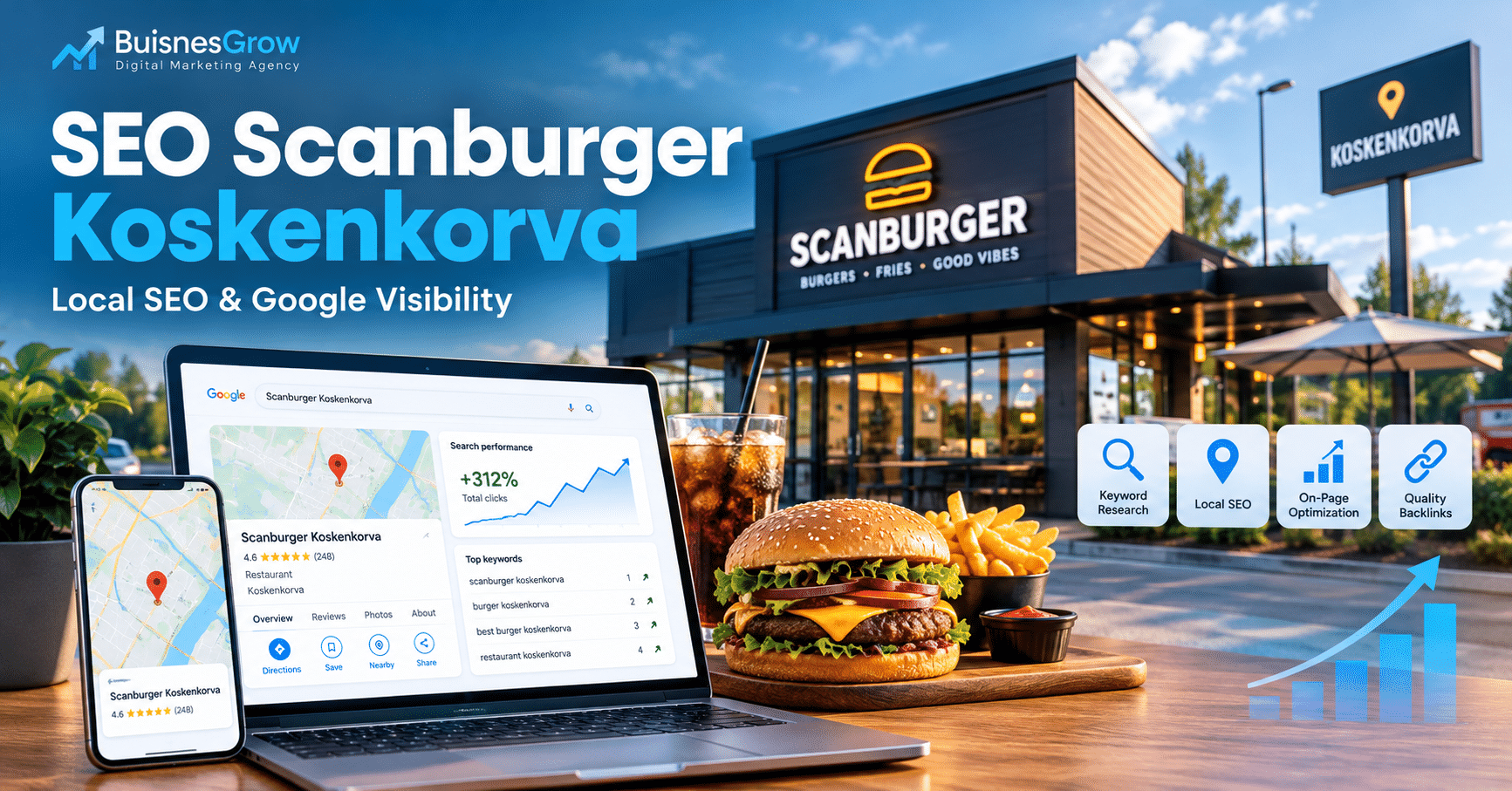
SEO for a query like “seo scanburger koskenkorva” means optimizing a website so that branded Finnish food and drink terms, such as a burger brand and a well-known grain-spirit town and label, are found by the right audience on Google and cited in AI-generated answers. The winning approach combines clear entity signals, local relevance for Finland, structured data, helpful long-form content, fast and mobile-friendly pages, and trustworthy links. A specialist team such as Business Grow can build this process for you through its organic SEO services.
Table of Contents
- What “SEO Scanburger Koskenkorva” Really Means
- Why Finnish Brand Keywords Need a Different SEO Approach
- How Google AI Overviews Decide What to Cite
- Keyword Research for Food and Beverage Brands
- On-Page SEO That Works for Brand Pages
- Technical SEO Foundations
- Local SEO for Finland
- Content Strategy for Burger and Beverage Brands
- Link Building and Brand Authority
- E-commerce, Design and Conversion
- Compliance, Trust and Responsible Marketing
- Measuring Results
- A 90-Day SEO Roadmap
- Frequently Asked Questions
- Final Thoughts
1. What “SEO Scanburger Koskenkorva” Really Means
At first glance, “seo scanburger koskenkorva” looks like an unusual search phrase. It mixes the term SEO with two names that most people associate with Finland: Scanburger, which readers will recognise as a burger-style food brand name, and Koskenkorva, which is both a place name and a widely known Finnish spirit label. Whether someone typed this phrase out of curiosity, because they are researching Finnish brands, or because they own a business in the food and beverage space, the intent behind it is clear enough to plan for.
Searchers using a keyword like this usually fall into one of four groups:
- Business owners who want to learn how brands in the Finnish food and drink industry are promoted online.
- Marketers and students who study brand SEO case patterns for regional products.
- Restaurant and retail owners who want to rank for their own brand names and for product searches.
- Agencies and freelancers who need a repeatable approach for multi-brand, multi-language food clients.
This article is written for all four groups. It does not claim any partnership with, endorsement by, or inside knowledge of any specific company. The brand names are used as examples of the kind of branded, locally rooted search terms that Finnish food and beverage businesses compete for. Everything below is practical SEO guidance that you can apply to your own site, whether you sell burgers, snacks, drinks, groceries, or hospitality services.
The key idea is simple. When a keyword is made of brand names and place names, Google treats it as an entity query. Instead of matching exact words only, Google tries to understand which real-world things you are asking about, how they relate, and which pages describe them best. Winning that kind of search means becoming a clear, well-documented source of truth about your own entity.
2. Why Finnish Brand Keywords Need a Different SEO Approach
Finland is a small, digitally advanced market with high internet use, strong mobile habits, and a language that behaves very differently from English. That changes how SEO should be planned.
Language and word forms
Finnish is a highly inflected language. A single noun can appear in many forms depending on case, so a search for a product name may appear in several variations. Good keyword research therefore has to capture base forms, common inflections, and English crossover terms. Many Finnish users also search in English for international brands, so a bilingual approach often pays off.
Strong brand loyalty and branded search
Food and drink categories in Finland include long-established labels that people search for by name. For a brand like this, a large share of traffic is branded search: users already know what they want and need to be guided to the right page, store locator, menu, or product list. Your job is to own the results page for those searches with accurate titles, rich snippets, and consistent information across the web.
Regional and seasonal behavior
Finnish search demand follows the seasons and the calendar. Summer terraces, midsummer, Christmas, student events, and sports seasons all change what people look for. A food or beverage brand that plans content around these moments captures traffic that generic competitors miss.
Regulation shapes content
Some categories, especially alcohol, are subject to strict marketing rules in Finland. That means SEO writers must focus on factual, informational, and cultural content rather than promotional claims. We cover this in detail in section 11.
Because of these differences, copying a generic English SEO checklist is rarely enough. A strong plan adapts to language, culture, law, and search behavior.
3. How Google AI Overviews Decide What to Cite
AI Overviews are the generated summaries that sit at the top of many Google results. They pull together an answer from several sources and show links to the pages that support it. To be one of those sources, a page needs more than keywords. Based on publicly discussed best practices, the following signals matter most.
Direct answers near the top
Pages that state a clear, concise answer early, followed by supporting detail, are easier for systems to extract. That is why this article opens with a short summary box. Use a definition, a number, or a step list in the first few lines of each section.
Clear structure
Descriptive headings, short paragraphs, bullet points, tables, and FAQs make content scannable for both people and machines. Each heading should describe exactly what the section answers.
Entity clarity
Name the brand, the product, the location, the category, and the relationship between them in plain language. Use consistent naming across your site, social profiles, and directory listings. When Google sees the same facts repeated reliably, confidence rises.
Experience, expertise, authoritativeness, and trust
Google’s quality guidelines describe E-E-A-T. Show who wrote the content, why they are qualified, how you gather your facts, and how users can contact you. For food and beverage topics, accuracy and transparency about ingredients, origin, and rules are essential.
Freshness and accuracy
Update menus, opening hours, product lists, and prices. Out-of-date pages lose trust quickly, and AI systems tend to prefer sources that look maintained.
Technical accessibility
If crawlers cannot reach, render, or understand your page, it cannot be cited. Clean HTML, structured data, fast loading, and mobile usability are the foundation.
A practical way to think about it: write for a curious person first, then format for a machine that has to summarize you in two sentences.
4. Keyword Research for Food and Beverage Brands
Strong keyword research starts with understanding what people actually want, not only what they type.
Step 1: Map the search intent types
- Navigational: the user wants a specific brand site, menu, or store page.
- Informational: the user wants history, ingredients, origin, nutritional facts, or how something is made.
- Commercial investigation: the user compares options, reads reviews, or looks for the best product in a category.
- Transactional: the user wants to order, reserve, buy, or find a nearby location.
For a keyword like “seo scanburger koskenkorva,” the intent is mixed and mostly informational or exploratory. A helpful page therefore explains concepts, gives examples, and points to next steps.
Step 2: Build keyword clusters
Group related terms into clusters so that each page targets a topic rather than a single phrase. For a burger brand, a cluster might include menu items, ingredients, delivery, locations, and opening hours. For a beverage brand, a cluster might include history, production region, serving suggestions, cocktail ideas where legally appropriate, and responsible consumption information.
Step 3: Collect Finnish and English variants
Use keyword tools, Google Search Console queries, autocomplete suggestions, and “People also ask” boxes. Record Finnish inflections, English equivalents, common misspellings, and abbreviations. Misspellings of brand names are often high-volume and low-competition.
Step 4: Prioritize by value and difficulty
Score each cluster by business value, search volume, competition, and how quickly you can create a better page than what already ranks. Start with clusters where you have unique expertise or first-hand data.
Step 5: Assign one primary topic per URL
Avoid keyword cannibalization. Each page should have one main purpose, one primary keyword, and a handful of supporting terms.
If you want a team to run this research for you, our SEO audit is the best starting point because it reveals gaps before you spend on content.
5. On-Page SEO That Works for Brand Pages
On-page optimization is where strategy turns into pages.
Title tags
Write a unique title for every page, ideally under about 60 characters. Place the main topic first, add the brand where it fits, and make the promise clear. Example pattern: “Burger Menu and Locations | Brand Name.”
Meta descriptions
Meta descriptions do not directly raise rankings, but they influence clicks. Write 140 to 155 characters that summarize the page, include a benefit, and invite action.
Headings
Use one H1 per page that matches the topic. Use H2 and H3 headings to cover subtopics, questions, and steps. Phrase some headings as questions, since they map well to featured snippets and AI summaries.
URL structure
Keep URLs short, readable, and lowercase. Use hyphens, avoid unnecessary parameters, and reflect the site hierarchy, for example /menu/burgers/ rather than /page?id=482.
Body content
Lead with the answer, then expand. Use short paragraphs, plain language, and concrete detail such as ingredients, origin, serving size, or service area. Add original photos with descriptive file names and alt text.
Internal linking
Link related pages together using descriptive anchor text. Internal links help users and crawlers understand which pages matter. For example, a guide about site structure should point readers to relevant service pages like UI and UX design when design affects usability.
Structured data
Add schema markup that matches the content. Common types for this industry include Organization, LocalBusiness, Restaurant, Menu, Product, Offer, FAQPage, BreadcrumbList, and Article. Validate everything before publishing and keep the markup consistent with what users can see.
Images and video
Compress images, use modern formats, and add captions where helpful. Short videos showing preparation, brand history, or store tours increase time on page and can earn their own search visibility.
6. Technical SEO Foundations
Even the best content fails if the site is hard to crawl or slow to load.
Crawlability and indexing
- Submit an XML sitemap in Google Search Console.
- Keep your robots.txt simple and avoid blocking important resources.
- Fix redirect chains and replace broken links with working pages.
- Use canonical tags to prevent duplicate content problems, especially on filtered menu and product pages.
Core Web Vitals and speed
Google measures loading, interactivity, and visual stability. Improve them by compressing images, using caching, minimizing heavy scripts, and choosing reliable hosting. Food sites are image-heavy, so image optimization often delivers the biggest win.
Mobile-first design
Most food and drink searches happen on phones. Buttons must be easy to tap, menus must be readable without zooming, and key actions such as call, order, or directions should be reachable in one tap.
Security and trust
Serve the whole site over HTTPS, keep software updated, and display clear contact details, privacy information, and terms.
International and language setup
If you publish in Finnish and English, use hreflang tags so the correct version appears for the right audience. Keep translations natural rather than machine-literal, and avoid mixing languages on a single page.
Log files and monitoring
For larger sites, review server logs to see how Googlebot crawls. Set up alerts for sudden drops in indexed pages, spikes in errors, or security warnings.
A technical review is part of every strong engagement. If your site has not been checked recently, a web design and development refresh can solve structural issues at the root rather than patching them one by one.
7. Local SEO for Finland
For any brand with physical locations, local SEO is a major growth lever. Even for national brands, local visibility drives walk-in traffic, reservations, and delivery orders.
Google Business Profile
Claim and verify every location. Complete every field: name, address, phone, hours, categories, services, menu links, and attributes. Add real photos regularly and respond to reviews in a professional tone.
Consistent NAP data
Name, address, and phone number must match across your website, directories, social profiles, and map listings. Small inconsistencies can reduce trust.
Location pages
Create a unique page for each branch. Include the address, opening hours, parking or transit details, local landmarks, a map embed, and unique descriptive text. Avoid copying the same paragraph across locations.
Reviews and reputation
Encourage satisfied customers to leave honest reviews. Never buy reviews or offer incentives that violate platform rules. Respond to criticism calmly and fix recurring problems; reviews influence both rankings and conversions.
Local content
Write about neighborhood events, seasonal menus, and community involvement. Content tied to real places helps search engines connect your brand to a geography.
If you manage several branches or serve specific cities, our local SEO service is built exactly for this kind of work.
8. Content Strategy for Burger and Beverage Brands
Content is how you earn visibility for hundreds of long-tail searches that a single homepage can never capture.
Pillar and cluster model
Build a pillar page for each core topic, then surround it with detailed cluster articles that link back to it.
Example for a burger brand:
- Pillar: Complete guide to our burger menu
- Clusters: ingredients and sourcing, vegetarian options, allergen information, family meal ideas, delivery areas, seasonal specials
Example for a beverage brand:
- Pillar: Guide to the product, its origin, and its heritage
- Clusters: production process, regional history, tasting notes, storage and serving information, responsible drinking advice
Content formats that earn citations
- Definitions and explainers with a one-sentence answer at the top.
- Comparison tables that contrast options clearly.
- Step-by-step guides with numbered lists.
- FAQ sections that answer real customer questions.
- Original data, such as surveys, menu statistics, or customer preferences, which other sites may reference.
Writing for people and AI systems
Use plain language. Define terms. Give specific facts instead of vague praise. State sources when you cite statistics. Keep each paragraph focused on one idea so that a summary system can lift it cleanly.
Content calendar
Plan around Finnish seasons and events: spring student celebrations, summer outdoor dining, midsummer, autumn comfort food, Christmas gatherings, and the new year. Publishing a few weeks before each peak gives search engines time to index and rank your pages.
Refresh old content
Update top-performing articles at least twice a year. Add new sections, fix outdated facts, improve visuals, and republish with an honest updated date.
Sample outline for a “seo scanburger koskenkorva” style article
- Short answer and summary
- Who the search is for
- How brand and place-name keywords work
- Step-by-step optimization plan
- Examples and checklists
- FAQs
- Clear call to action
Following this outline keeps the page useful and easy to cite.
9. Link Building and Brand Authority
Links remain a major trust signal, but quality matters far more than quantity.
Earn links with useful assets
- Original research, such as a consumer preference survey.
- Free tools, calculators, or printable guides.
- Well-designed infographics that explain a process.
- Expert commentary offered to journalists and bloggers.
Local and industry citations
Get listed in reputable Finnish business directories, tourism pages, chamber of commerce listings, and food or hospitality associations. These citations support local SEO and add legitimate referral traffic.
Digital PR
Pitch stories that are genuinely newsworthy: a new product launch, a charity partnership, a sustainability initiative, or a milestone anniversary. Local news sites, food bloggers, and event organizers may cover them.
Partnerships and sponsorships
Sponsoring local events, teams, or community projects can create natural mentions and links, as long as the relationship is real and disclosed properly.
Unlinked brand mentions
Search for mentions of your brand that do not link to you. A polite outreach message asking the author to add a link often succeeds.
What to avoid
Do not buy links, join link exchanges, or use automated comment spam. These tactics can trigger penalties and waste budget. A slow, steady profile of relevant links is safer and more durable.
Brand strength also affects links. A recognisable visual identity encourages sharing, which is why many clients pair SEO with brand and identity design to make their presence memorable and consistent.
10. E-commerce, Design and Conversion
Rankings only matter if visitors take action. That is where design and conversion work meet SEO.
Product and menu pages
Each product or menu item deserves a page or a clearly structured section with a description, price, availability, images, ingredients, and relevant schema. Avoid thin pages with only a name and a photo.
Category structure
Organize categories logically and limit depth. Users and crawlers should be able to reach any product within about three clicks from the homepage.
Faceted navigation
If filters create thousands of URL combinations, control them with canonical tags, noindex rules where appropriate, and a smart internal linking plan.
Checkout and ordering flow
Reduce friction. Offer guest checkout, clear delivery information, visible payment options, and transparent totals. Simplify forms and show progress indicators.
Trust elements
Display reviews, return policies, secure payment badges, and contact options. These reassure first-time buyers.
Visual quality
Strong photography, readable typography, and consistent spacing build credibility. If your store or ordering site needs a rebuild, a purpose-built e-commerce website design can raise both conversion rate and search performance.
Social and paid support
Organic search is powerful, but it grows faster with supporting channels. Social posts and campaigns introduce your brand to new audiences, while paid search can capture demand during the months when organic rankings are still building. Explore our digital marketing service for coordinated campaigns that support your SEO work.
11. Compliance, Trust and Responsible Marketing
Responsible SEO is part of long-term success, especially in categories with legal limits.
Alcohol-related content
Many countries, including Finland, regulate how alcohol can be advertised. Rules typically restrict promotional messaging, especially for stronger products, and can affect websites, social media, and influencer content. Before publishing anything about a spirit brand, review the current national rules or consult a qualified legal professional. As a safe SEO approach, focus on factual information such as history, geography, production methods, and responsible-use guidance rather than persuasive claims. Nothing in this article is legal advice.
Food information
Ingredient lists, allergen notices, and nutritional details should be accurate and easy to find. Misleading claims damage trust and can lead to regulatory problems.
Privacy and cookies
If you operate in Finland or serve European visitors, follow GDPR requirements. Provide a clear privacy policy, use compliant cookie consent, and respect data deletion requests.
Age-appropriate presentation
For any content related to alcohol, include an age notice and avoid imagery or messaging aimed at minors.
Honest endorsements
Disclose paid partnerships and sponsored posts. Do not imply that your site is affiliated with a brand unless that relationship is real.
Accessibility
Use sufficient color contrast, alt text, keyboard-friendly navigation, and readable fonts. Accessible sites tend to perform better for everyone.
Being careful about compliance does not weaken SEO. It strengthens the trust signals Google and users look for.
12. Measuring Results
Without measurement, SEO becomes guesswork. Track a mix of visibility, engagement, and revenue metrics.
Core tools
- Google Search Console: impressions, clicks, average position, indexing status, and Core Web Vitals.
- Google Analytics: traffic sources, engagement, conversions, and user paths.
- Google Business Profile insights: calls, direction requests, and profile views.
- Rank tracking tools: keyword positions by country, city, and device.
Key performance indicators
| Metric | What it tells you | Review frequency |
|---|---|---|
| Organic impressions | Overall visibility | Weekly |
| Organic clicks | Interest from searchers | Weekly |
| Click-through rate | Strength of titles and snippets | Monthly |
| Average position | Ranking progress | Monthly |
| Conversions from organic | Business impact | Monthly |
| Branded vs non-branded traffic | Awareness vs discovery | Quarterly |
| Referring domains | Authority growth | Quarterly |
| AI Overview mentions | Citation visibility | Quarterly |
Tracking AI visibility
Search a set of target questions regularly and note whether your pages appear as cited sources. Record which pages are cited and which competitors appear instead. This reveals content gaps you can fix.
Reporting rhythm
Create a simple monthly report: what was done, what changed, what was learned, and what comes next. Clear reporting builds confidence and keeps the plan aligned with goals.
13. A 90-Day SEO Roadmap
Here is a practical roadmap for a food and beverage brand starting from scratch.
Days 1 to 30: Foundation
- Complete a full technical and content audit.
- Set up Search Console, Analytics, and conversion tracking.
- Research Finnish and English keywords and build clusters.
- Fix critical errors: broken links, slow pages, missing mobile features, duplicate titles.
- Claim and complete all Google Business Profiles.
Days 31 to 60: Build
- Rewrite titles, descriptions, and headings for priority pages.
- Add structured data to key templates.
- Publish the first pillar page and three to five cluster articles.
- Create or improve location pages.
- Begin gathering reviews and local citations.
Days 61 to 90: Grow
- Launch outreach for links and digital PR.
- Publish additional cluster content tied to upcoming seasons.
- Test and refine calls to action and landing pages.
- Review early ranking and traffic data, then double down on what works.
- Plan the next quarter with a prioritized backlog.
Budget expectations
SEO is an ongoing investment, and results typically build over several months. Agency packages vary by scope. You can review current plans on our pricing page and choose a level that matches the number of keywords, content pieces, and technical tasks you need.
14. Frequently Asked QuestionsWhat does “seo scanburger koskenkorva” mean?
It is a search phrase that combines the term SEO with two Finnish brand and place names. It is best understood as an entity-style query related to optimizing the online presence of food and beverage brands in Finland. This article uses it as a framework for explaining how to do that effectively.
Can a small food brand really rank on Google?
Yes. Smaller brands win by being specific. Detailed location pages, helpful menus, clear product information, and strong local signals often outperform larger competitors on targeted searches.
How long does SEO take to work?
Most sites see early movement within two to four months, with stronger gains after six to twelve months. Timing depends on competition, site health, content quality, and link profile.
Do I need Finnish content if my audience speaks English?
If your customers are in Finland, Finnish content is usually essential. English pages can supplement it, especially for tourists and international buyers, but Finnish-language pages capture the majority of local searches.
How do I get into Google AI Overviews?
There is no switch to flip. Publish accurate, well-structured, expert content; answer questions directly; use structured data; keep pages fast and crawlable; and earn trust through reputable mentions and links.
Is it safe to use another brand’s name in my content?
Use brand names descriptively and honestly, avoid implying affiliation, and respect trademark rules. When in doubt, seek professional legal advice.
What is the difference between SEO and paid ads?
SEO earns unpaid visibility over time, while paid ads buy immediate placement. Many brands combine both: ads for fast demand capture, SEO for compounding, lower-cost traffic.
Should I hire an agency or do SEO myself?
If you have time and technical skills, you can handle the basics. If you want speed, expertise, and consistent execution across technical, content, and link work, an agency can save time and reduce costly mistakes.
How much does professional SEO cost?
Costs vary by market and scope. Our published monthly plans start at an accessible entry level and scale with keyword targets and content volume. Visit the pricing page for details.
Where can I get a free consultation?
You can reach the team through the contact page to discuss your goals and receive a tailored recommendation.
15. Final Thoughts
“SEO scanburger koskenkorva” may look like an unusual keyword, but it points to a very real challenge: how to make locally rooted food and beverage brands visible, trusted, and easy to find in a search landscape that now includes AI-generated answers. The solution is not a trick. It is a disciplined combination of research, clear entity signals, helpful content, solid technical performance, local relevance, ethical link building, and careful compliance.
If you remember only five things, remember these:
- Answer the searcher’s question clearly and early.
- Be consistent about who you are, what you offer, and where you operate.
- Build pages that are fast, mobile-friendly, and structured for both people and machines.
- Earn trust through accurate information, reviews, and reputable mentions.
- Measure, learn, and improve every month.
Ready to turn these ideas into measurable growth? Business Grow can audit your site, plan your keywords, create ranking-ready content, and manage the ongoing work for you.